
OAR Exam Free Study Guide unit 2: OAR Math Skills Core Concepts
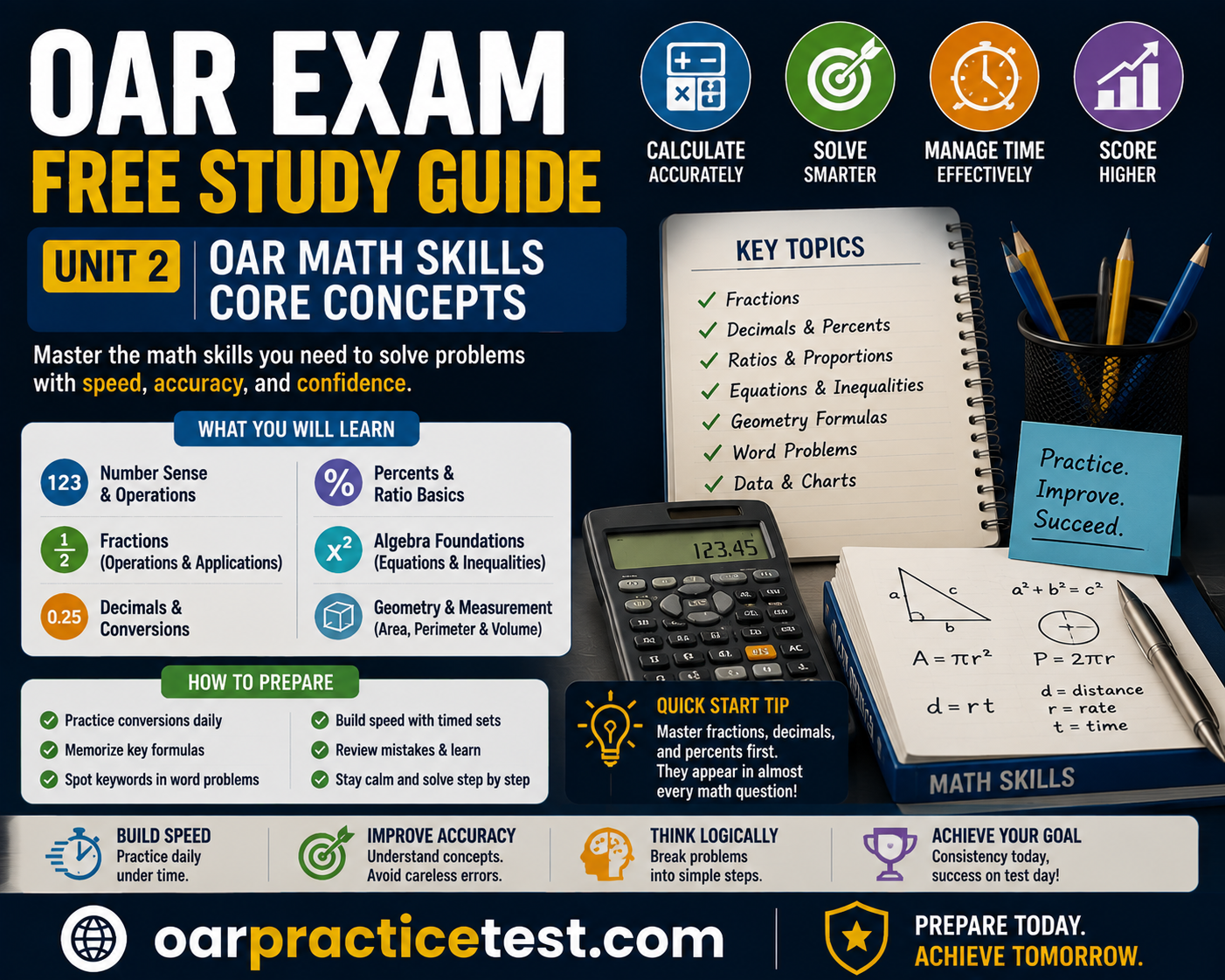
The OAR Math Skills Core section checks how well you handle basic numbers, algebra, geometry, and real-life word problems.
It is designed to measure clear thinking, accuracy, and speed rather than advanced math theory.
This section usually includes topics like fractions, decimals, percents, ratios, equations, inequalities, area, perimeter, volume, and simple rate problems.
Many questions are short, but they can feel tricky if you do not read carefully or choose the wrong formula.
A good way to think about this section is: convert, simplify, solve, and check. First, understand what the question is asking. Then convert the information into the right form, simplify the expressions, solve step by step, and finally check whether the answer makes sense.
What to focus on
- Basic arithmetic with whole numbers, fractions, decimals, and percents.
- Solving one-step and multi-step equations.
- Working with ratios and proportions.
- Geometry formulas for area, perimeter, and volume.
- Word problems involving speed, distance, time, and mixtures.
- Reading charts, tables, and simple data.
How to prepare
- Practice fraction-decimal-percent conversions until they feel automatic.
- Memorize common formulas like area, perimeter, and d=rt.
- Learn to spot keywords in word problems.
- Work on speed, because time management matters a lot.
- Review mistakes carefully so you do not repeat them.
Exam mindset
The math section is not only about calculation. It is also about understanding the question correctly and staying calm under time pressure.
If you can break a problem into small steps, most questions become much easier.
Subtopic of OAR Math Skills Section
2.1 Number Sense & Operations
What it is and why it matters
Number Sense & Operations covers the basic manipulation of whole numbers, integers, fractions, decimals, percents, ratios, and simple arithmetic shortcuts. This layer is the backbone of the OAR math section — if a test‑taker is comfortable with these operations, many other questions (algebra, geometry, word problems) become far easier.
Core skills and tips
- Whole numbers & integers: be fluent with addition, subtraction, multiplication, and division, and understand how negative signs behave (for example, negative times negative gives positive). Use factorizations and mental tricks (break numbers into easier parts) to speed up calculations.
- Fraction basics: know types of fractions (proper, improper, mixed), convert between improper and mixed forms, and reduce to lowest terms to keep numbers manageable.
- Decimal fluency: align decimals for addition/subtraction and know place value for rounding; shift decimal points when multiplying or dividing by powers of ten.
- Quick mental methods: practice doubling/halving, distributive splits (e.g., 17×6 = (10+7)×6), and factoring common factors to simplify fractions before multiplying.
Common question patterns
- Straight arithmetic with small integers or decimals.
- Quick simplification or reduction problems.
- Comparisons (which of these fractions is largest?).
Practice prompt
“Compute 3.75 × 0.8, then round to two decimal places.”
2.2 Fractions (Operations and Applications)
What it is and why it matters
Fractions appear in many OAR items, both as raw numerical entries and embedded inside word problems (mixtures, portions, capacities). Handling fractions accurately and quickly avoids many common errors.
Step‑by‑step methods
- Addition/Subtraction: find a least common denominator (LCD), rewrite numerators, then combine and simplify. If denominators are multiples, use the larger denominator to save time.
- Multiplication: multiply numerators, multiply denominators, then simplify early by canceling common factors.
- Division: multiply by the reciprocal of the divisor (flip the second fraction) and simplify.
- Mixed numbers: convert to improper fractions for calculation, then back to mixed form if a simpler interpretation is needed.
Traps and speed tips
- Always simplify before multiplying, if possible.
- Watch for nested fractions (fractions inside fractions) — clear denominators early.
- For subtraction, ensure common denominator and then subtract numerators carefully to avoid sign mistakes.
Common question patterns
- Fraction of an amount (e.g., 3/4 of the tank).
- Remaining fraction after usage (subtracting fractions).
- Mixture of fractions (combine different fractional parts of a total).
Practice prompt
“A bottle is filled to 7/8 of its capacity. After pouring out 1/3 of what’s in the bottle, what fraction of the full bottle remains?”
2.3 Decimals & Conversions
What it is and why it matters
Decimals are simply another way to express parts of a whole. The test will present decimals in calculations and in conversions to/from fractions and percent. Being comfortable converting and manipulating decimals prevents avoidable arithmetic mistakes.
Practical guidance
- Converting: fraction → decimal via division; decimal → percent by ×100; percent → decimal by ÷100.
- Arithmetic: line up decimal points for addition/subtraction; for multiplication, multiply as integers then place the decimal by counting decimal places in factors; for division, shift both dividend and divisor to remove decimals (multiply by 10^n).
- Rounding: know rules to round to required places and when to keep more precision during intermediate steps.
Common question patterns
- Compute 0.375 × 240.
- Convert a repeating decimal to fraction (occasionally), but most OAR decimals are terminating or simple fractions.
Practice prompt
“Convert 0.875 to a fraction and to a percent.”
2.4 Percents & Percent Problems
What it is and why it matters
Percent express parts out of 100 and are central to applied questions (discounts, markups, growth, statistics). Most percent questions fit predictable templates, so recognizing the template is the fastest path to the answer.
Three primary templates and how to solve them
- Percent of a number: convert percent to decimal and multiply (e.g., 18% of 250 → 0.18 × 250).
- Find the whole from a percent: set up 0.xx × total = part (e.g., 0.40 × x = 28).
- Percent increase/decrease: multiply the original value by (1 ± rate) (e.g., 12% increase → multiply by 1.12).
Quick tips
- Use proportions when it feels more natural: part/whole = percent/100.
- For successive percent changes, multiply by each (1 ± rate) factor sequentially.
- Watch whether problems ask for absolute difference or percent change (they want different formulas).
Common question patterns
- Sale price after discount, final price after tax, population growth by percentage, percent correct on a test.
Practice prompt
“A pair of boots costs $120 and is on sale for 25% off. What is the sale price?”
2.5 Ratios & Proportions
What it is and why it matters
Ratios compare quantities and proportions set two ratios equal. Many percent and mixture problems are more naturally solved by setting up proportions.
How to set up and solve
- Express a ratio a:b as fraction a/b.
- For proportions, cross‑multiply: if a/b = c/d, then ad = bc.
- Use unit rates when helpful (e.g., cost per unit), then scale up or down.
Common question patterns
- Scaling recipes, converting map scales, determining population ratios, mixing two concentrations.
Practice prompt
“A map uses a scale where 1 cm represents 12 km. How many kilometers does 7.5 cm represent?”
2.6 Algebra — Equations & Inequalities
What it is and why it matters
Algebra converts word problems into solvable equations. On the OAR, algebraic mastery means translating language into math and handling routine manipulations quickly.
Core techniques
- Define variables clearly (write what x means).
- Use inverse operations to isolate variables (undo addition with subtraction, undo multiplication with division).
- For inequalities, apply the same rules as equations, but flip the inequality sign when multiplying or dividing by a negative number.
- When fractions are present, multiply both sides by the least common denominator to clear fractions early.
Common question patterns
- Solve for x in linear equations, solve simple two‑step inequalities, translate age/work/money problems into equations.
Practice prompt
“Solve for x: 5(x − 2) = 3x + 8.”
2.7 Expressions, Factoring & Rearranging Formulas
What it is and why it matters
Simplifying expressions, factoring, and rearranging formulas are tools used across algebra and applied problems. They often appear as intermediate steps rather than as stand‑alone heavy algebra problems.
Key skills
- Combine like terms and use distributive property to expand or factor expressions.
- Factor common factors and simple binomials when convenient.
- Rearrange formulas: isolate the desired variable by algebraic manipulation (use inverse operations).
Common question patterns
- Expand or factor small expressions, solve for a variable in a formula given numeric values.
Practice prompt
“Rewrite A = (1/2)bh to solve for b in terms of A and h.”
2.8 Geometry — Angles & Lines
What it is and why it matters
Geometry questions on the OAR are practical and diagram‑based: they test whether a candidate recognizes angle relationships and can read simple figures.
Essential ideas
- Complementary angles sum to 90°, supplementary angles sum to 180°.
- Vertical angles (formed by intersecting lines) are equal.
- When a transversal cuts parallel lines, corresponding and alternate interior/exterior angles have predictable relationships.
Common question patterns
- Find a missing angle using angle relationships, determine whether lines are parallel from given angle information.
Practice prompt
“Two lines are cut by a transversal creating an alternate interior angle of 70°. What is the corresponding angle on the next parallel line?”
2.9 Geometry — Triangles, Polygons & Circles
What it is and why it matters
This covers area, perimeter, and basic circle facts that appear in dimension/diagram problems.
Core facts and formulas
- Triangle angle sum = 180°. Right triangles often use Pythagorean theorem: a^2 + b^2 = c^2.
- Area: triangle = (1/2) × base × height; rectangle = length × width.
- Circle: circumference = 2πr and area = πr^2. Use simple numeric values to avoid heavy π computations.
Common question patterns
- Compute area or perimeter from given dimensions, use Pythagorean theorem to find a missing side, solve problems where a shape is composed of simpler shapes.
Practice prompt
“A right triangle has legs 6 and 8. What is the hypotenuse length?”
2.10 Measurement, Units & Volume
What it is and why it matters
Volume and measurement test unit awareness and the ability to apply 3D formulas. Many practical problems ask for volumes or conversions between units.
Essential formulas
- Rectangular prism volume = length × width × height.
- Cylinder volume = πr^2h (rarely needs numeric π).
- Convert units by multiplying/dividing by appropriate powers of 10 (centimeters to meters) or known factors (inches to feet).
Common question patterns
- Determine volume of a storage box, convert units in multi‑step problems, or compute how many smaller containers fit in a larger one.
Practice prompt
“How many cubic centimeters are in a box 20 cm by 15 cm by 10 cm?”
2.11 Rate, Work & Distance Problems
What it is and why it matters
These applied problems model motion, work, or combined rates. They require setting up relationships such as distance = rate × time or combined worker rates.
How to approach
- Write the fundamental equation: distance = rate × time for motion problems.
- For combined work: add rates (worker A rate + worker B rate = combined rate). Solve for time by using total = rate × time.
- For relative speed: when two objects move toward each other, add speeds; when moving same direction, subtract.
Common question patterns
- Travel time, meeting point problems, work completion times for combined workers.
Practice prompt
“A pump fills a pool at 30 liters/min and another at 45 liters/min. How long to fill 3,000 liters together?”
2.12 Mixture & Concentration Problems
What it is and why it matters
Mixture problems are about combining two or more substances with different strengths or concentrations to get a final mix with the desired result.
At their core, they are ratio and proportion problems, because you compare the amount of each ingredient to the whole mixture.
Standard approach
- Represent amounts and concentrations consistently (fractions, decimals, or percents).
- Use the “amount of substance” model: total concentration = (sum of each part’s concentration × amount) / total amount.
- Set up an equation using parts or use proportion method to solve.
Common question patterns
- Mixing solutions with different percentages, blending alloys or fuels to reach a target composition.
Practice prompt
“How much 20% solution must be added to 80 liters of a 50% solution to obtain a 40% solution?”
2.13 Basic Data, Averages & Probability
What it is and why it matters
The OAR will test elementary data interpretation: mean, reading tables/charts, and simple probability. These questions measure numerical literacy and interpretation rather than deep statistics.
Core skills
- Mean (average) = sum of values / number of values.
- Read and extract values from simple tables or bar charts.
- Probability basics: probability = favorable outcomes / total outcomes; independent vs. dependent cases are rarely deep on OAR.
Common question patterns
- Find average score, determine probability of a single event, or read counts from a small table.
Practice prompt
“In a bag with 3 red, 5 blue, and 2 green marbles, what is the probability of drawing a blue marble?”
2.14 Multi‑step & Mixed Problems
What it is and why it matters
These combine several techniques: convert a percent to a fraction, use it in an equation, then compute a geometry or rate result. They’re common and test synthesis rather than new concepts.
Strategy checklist
- Read carefully and underline key numbers.
- Convert every quantity into a consistent form (same units, decimals or fractions).
- Define variables before writing equations.
- Work step‑by‑step and keep intermediate results exact until final rounding.
Practice prompt
“A tank is filled to 3/5 of its capacity. It then increases by 20% of the current amount. What fraction of the full tank is now filled?”
2.15 Quick study plan for all math topics
- Start with conversions and core arithmetic (15–20 minutes per day) until conversions are automatic.
- Alternate focused topic days (algebra, geometry, rates) with mixed practice days.
- Use short timed sets (20–30 questions in 30–40 minutes) to build exam pacing and switching speed.
- Maintain a memorized one‑page toolbox: common fraction↔decimal↔percent pairs, geometry formulas, d = rt, and percent templates.
OAR Math Practice Test
OAR Math Practice Test is designed to help you strengthen the core math skills needed for the OAR exam, including arithmetic, algebra, fractions, exponents, geometry, and problem-solving. This focused practice test gives you a clear way to assess your preparation, improve speed and accuracy, and build confidence before the exam.
Test Instructions
No. of Questions: 20
Questions: Multiple choice with 4 options (A, B, C, D)
Review: You can flag questions for review and return to them
Submission: Click “Submit Test” when ready to finish.