
Free OAR Practice Test 4 – Officer Aptitude Rating Test Prep 2026
Boost your OAR score with Free OAR Practice Test 4 from our series of Six OAR Practice Test , a focused mock test designed to match the actual OAR style and difficulty.
Take this free OAR practice test with 30 carefully designed questions covering all three OAR sections — Math Skills, Reading Comprehension, and Mechanical Comprehension — so you can check your strengths, find weak spots, and improve your speed before exam day. Each question includes a clear explanation to help you understand the method, not just the answer.
This free OAR Practice Test is ideal for learners who want realistic practice, better time management, and a strong review of key OAR concepts. Use it as a full-length practice session or section-by-section revision to build confidence and improve accuracy.
Quiz-summary
0 of 30 questions completed
Questions:
- 1
- 2
- 3
- 4
- 5
- 6
- 7
- 8
- 9
- 10
- 11
- 12
- 13
- 14
- 15
- 16
- 17
- 18
- 19
- 20
- 21
- 22
- 23
- 24
- 25
- 26
- 27
- 28
- 29
- 30
Information
Test Instructions
No. of Questions: 30
Questions: Multiple choice with 4 options (A, B, C, D)
Review: You can flag questions for review and return to them
Submission: Click “Submit Test” when ready to finish.
You have already completed the quiz before. Hence you can not start it again.
Quiz is loading...
You must sign in or sign up to start the quiz.
You have to finish following quiz, to start this quiz:
Results
0 of 30 questions answered correctly
Your time:
Time has elapsed
You have reached 0 of 0 points, (0)
| Average score |
|
| Your score |
|
Categories
- Not categorized 0%
- 1
- 2
- 3
- 4
- 5
- 6
- 7
- 8
- 9
- 10
- 11
- 12
- 13
- 14
- 15
- 16
- 17
- 18
- 19
- 20
- 21
- 22
- 23
- 24
- 25
- 26
- 27
- 28
- 29
- 30
- Answered
- Review
-
Question 1 of 30
1. Question
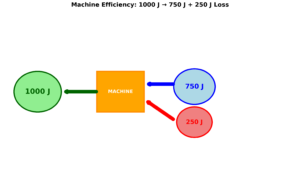
Refer to the figure. What is the efficiency of this machine if input work = 1000 J and output work = 750 J?
 Correct
Efficiency = (Output work / Input work) x 100% = (750/1000) x 100% = 75%.
Incorrect
Efficiency = (Output work / Input work) x 100% = (750/1000) x 100% = 75%.
-
Question 2 of 30
2. Question
Solve the inequality |2x – 3| > 7.
 Correct
|2x – 3| > 7 means 2x – 3 > 7 or 2x – 3 < -7. So 2x > 10 or 2x < -4. Therefore x > 5 or x < -2.
Incorrect
|2x – 3| > 7 means 2x – 3 > 7 or 2x – 3 < -7. So 2x > 10 or 2x < -4. Therefore x > 5 or x < -2.
-
Question 3 of 30
3. Question
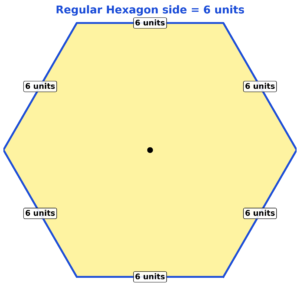
A regular hexagon has side length 6 units. What is its area?
 Correct
Area = (3√3/2)s² = (3√3/2)(36) = 54√3.
Incorrect
Area = (3√3/2)s² = (3√3/2)(36) = 54√3.
-
Question 4 of 30
4. Question
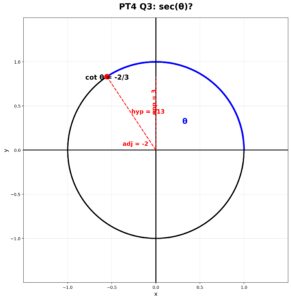
If cot(θ) = -2/3 and π/2 < θ < π, what is sec(θ)?
 Correct
tan(θ)=-3/2 → cos(θ)=-2/√13 → sec(θ)=-√13/2.
Incorrect
tan(θ)=-3/2 → cos(θ)=-2/√13 → sec(θ)=-√13/2.
-
Question 5 of 30
5. Question
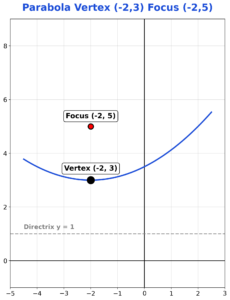
What is the equation of the parabola with vertex (-2, 3) and focus (-2, 5)?
 Correct
Distance vertex → focus = 2 units (p=|5-3|=2). Vertical parabola: (x+2)²=4p(y-3)=8(y-3).
Incorrect
Distance vertex → focus = 2 units (p=|5-3|=2). Vertical parabola: (x+2)²=4p(y-3)=8(y-3).
-
Question 6 of 30
6. Question
Find the limit: lim(x→0) (sin(3x))/x ?
Correct
Standard limit: lim sin(ax)/x = a as x→0. Here a=3.
Incorrect
Standard limit: lim sin(ax)/x = a as x→0. Here a=3.
-
Question 7 of 30
7. Question
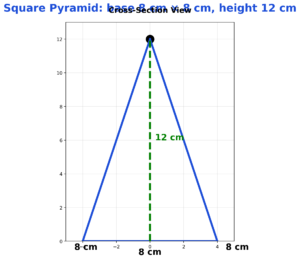
A pyramid has a square base with side 8 cm and height 12 cm. What is its volume?
 Correct
V = (1/3) × base area × height = (1/3) × 8² × 12 = (1/3) × 64 × 12 = 256 cm³.
Incorrect
V = (1/3) × base area × height = (1/3) × 8² × 12 = (1/3) × 64 × 12 = 256 cm³.
-
Question 8 of 30
8. Question
If z₁ = 3 + 4i and z₂ = 2 – i, what is z₁ · z₂?
Correct
(3+4i)(2-i) = 6 – 3i + 8i – 4i² = 6 + 5i + 4 = 10 + 5i (i²=-1).
Incorrect
(3+4i)(2-i) = 6 – 3i + 8i – 4i² = 6 + 5i + 4 = 10 + 5i (i²=-1).
-
Question 9 of 30
9. Question
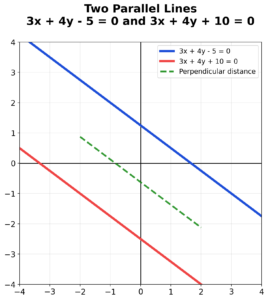
What is the distance between the lines 3x + 4y – 5 = 0 and 3x + 4y + 10 = 0?
 Correct
Parallel lines distance = |c₁ – c₂|/√(a² + b²) = |-5 – (+10)|/√(9+16) = 15/5 = 3.
Incorrect
Parallel lines distance = |c₁ – c₂|/√(a² + b²) = |-5 – (+10)|/√(9+16) = 15/5 = 3.
-
Question 10 of 30
10. Question
If the parametric equations are x=3t+1, y=2t-4, what is dy/dx?
Correct
dy/dx = (dy/dt)/(dx/dt) = 2/3.
Incorrect
dy/dx = (dy/dt)/(dx/dt) = 2/3.
-
Question 11 of 30
11. Question
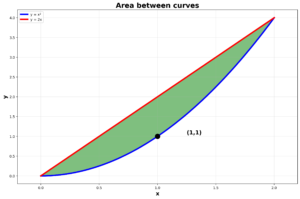
What is the area between y=x² and y=2x from x=0 to x=2?
 Correct
Area = ∫₀² (2x – x²) dx = [x² – (1/3)x³] from 0 to 2 = [4 – (1/3)(8)] – [0] = [4 – 8/3] = 12/3 – 8/3 = 4/3.
Incorrect
Area = ∫₀² (2x – x²) dx = [x² – (1/3)x³] from 0 to 2 = [4 – (1/3)(8)] – [0] = [4 – 8/3] = 12/3 – 8/3 = 4/3.
-
Question 12 of 30
12. Question
Passage: ‘Fiber optic communication systems transmit data using light pulses through optical fibers made of ultra-pure glass. Total internal reflection keeps light signals confined within the fiber core, allowing transmission over vast distances with minimal signal degradation. The critical angle for total internal reflection depends on the refractive indices of the core and cladding materials, typically requiring the core to have a higher refractive index than the cladding.’
What principle keeps light confined in optical fibers?
Correct
The passage explicitly states: ‘Total internal reflection keeps light signals confined within the fiber core.’
Incorrect
The passage explicitly states: ‘Total internal reflection keeps light signals confined within the fiber core.’
-
Question 13 of 30
13. Question
Passage: ‘Fiber optic communication systems transmit data using light pulses through optical fibers made of ultra-pure glass. Total internal reflection keeps light signals confined within the fiber core, allowing transmission over vast distances with minimal signal degradation. The critical angle for total internal reflection depends on the refractive indices of the core and cladding materials, typically requiring the core to have a higher refractive index than the cladding.’
According to the passage, what determines the critical angle for total internal reflection?
Correct
The passage states: ‘The critical angle for total internal reflection depends on the refractive indices of the core and cladding materials.’
Incorrect
The passage states: ‘The critical angle for total internal reflection depends on the refractive indices of the core and cladding materials.’
-
Question 14 of 30
14. Question
Passage: ‘Fiber optic communication systems transmit data using light pulses through optical fibers made of ultra-pure glass. Total internal reflection keeps light signals confined within the fiber core, allowing transmission over vast distances with minimal signal degradation. The critical angle for total internal reflection depends on the refractive indices of the core and cladding materials, typically requiring the core to have a higher refractive index than the cladding.’
For total internal reflection to occur, the passage suggests:
Correct
The passage states this ‘typically requiring the core to have a higher refractive index than the cladding.’
Incorrect
The passage states this ‘typically requiring the core to have a higher refractive index than the cladding.’
-
Question 15 of 30
15. Question
Passage: ‘Computational fluid dynamics (CFD) employs numerical methods to solve the Navier-Stokes equations, which govern fluid motion. These partial differential equations describe conservation of mass, momentum, and energy in fluid flows. CFD simulations enable engineers to visualize complex flow patterns, predict pressure distributions, and optimize designs before physical prototyping, significantly reducing development costs and time.’
What do the Navier-Stokes equations describe?
Correct
The passage states: ‘These partial differential equations describe conservation of mass, momentum, and energy in fluid flows.’
Incorrect
The passage states: ‘These partial differential equations describe conservation of mass, momentum, and energy in fluid flows.’
-
Question 16 of 30
16. Question
Passage: ‘Computational fluid dynamics (CFD) employs numerical methods to solve the Navier-Stokes equations, which govern fluid motion. These partial differential equations describe conservation of mass, momentum, and energy in fluid flows. CFD simulations enable engineers to visualize complex flow patterns, predict pressure distributions, and optimize designs before physical prototyping, significantly reducing development costs and time.’
According to the passage, CFD simulations help engineers by:
Correct
The passage mentions CFD enables engineers to ‘visualize complex flow patterns, predict pressure distributions, and optimize designs.’
Incorrect
The passage mentions CFD enables engineers to ‘visualize complex flow patterns, predict pressure distributions, and optimize designs.’
-
Question 17 of 30
17. Question
Passage: ‘Computational fluid dynamics (CFD) employs numerical methods to solve the Navier-Stokes equations, which govern fluid motion. These partial differential equations describe conservation of mass, momentum, and energy in fluid flows. CFD simulations enable engineers to visualize complex flow patterns, predict pressure distributions, and optimize designs before physical prototyping, significantly reducing development costs and time.’
The main advantage of CFD mentioned in the passage is:
Correct
The passage concludes that CFD ‘significantly reducing development costs and time.’
Incorrect
The passage concludes that CFD ‘significantly reducing development costs and time.’
-
Question 18 of 30
18. Question
Passage: ‘Composite materials combine two or more constituent materials with different physical or chemical properties to achieve characteristics unattainable by individual components. Carbon fiber reinforced polymers (CFRP) exemplify this concept, offering high strength-to-weight ratios essential for aerospace applications. The carbon fibers provide tensile strength while the polymer matrix distributes loads and protects fibers from environmental damage.’
What makes composite materials advantageous?
Correct
The passage states composites are designed ‘to achieve characteristics unattainable by individual components.’
Incorrect
The passage states composites are designed ‘to achieve characteristics unattainable by individual components.’
-
Question 19 of 30
19. Question
Passage: ‘Composite materials combine two or more constituent materials with different physical or chemical properties to achieve characteristics unattainable by individual components. Carbon fiber reinforced polymers (CFRP) exemplify this concept, offering high strength-to-weight ratios essential for aerospace applications. The carbon fibers provide tensile strength while the polymer matrix distributes loads and protects fibers from environmental damage.’
In CFRP, what role do carbon fibers serve?
Correct
The passage states: ‘The carbon fibers provide tensile strength while the polymer matrix distributes loads.’
Incorrect
The passage states: ‘The carbon fibers provide tensile strength while the polymer matrix distributes loads.’
-
Question 20 of 30
20. Question
Passage: ‘Composite materials combine two or more constituent materials with different physical or chemical properties to achieve characteristics unattainable by individual components. Carbon fiber reinforced polymers (CFRP) exemplify this concept, offering high strength-to-weight ratios essential for aerospace applications. The carbon fibers provide tensile strength while the polymer matrix distributes loads and protects fibers from environmental damage.’
What function does the polymer matrix serve in CFRP?
Correct
The passage explains the polymer matrix ‘distributes loads and protects fibers from environmental damage.’
Incorrect
The passage explains the polymer matrix ‘distributes loads and protects fibers from environmental damage.’
-
Question 21 of 30
21. Question
Passage: ‘Composite materials combine two or more constituent materials with different physical or chemical properties to achieve characteristics unattainable by individual components. Carbon fiber reinforced polymers (CFRP) exemplify this concept, offering high strength-to-weight ratios essential for aerospace applications. The carbon fibers provide tensile strength while the polymer matrix distributes loads and protects fibers from environmental damage.’
CFRP is particularly valuable for aerospace applications because of its:
Correct
The passage mentions CFRP ‘offering high strength-to-weight ratios essential for aerospace applications.’
Incorrect
The passage mentions CFRP ‘offering high strength-to-weight ratios essential for aerospace applications.’
-
Question 22 of 30
22. Question
Passage: ‘Composite materials combine two or more constituent materials with different physical or chemical properties to achieve characteristics unattainable by individual components. Carbon fiber reinforced polymers (CFRP) exemplify this concept, offering high strength-to-weight ratios essential for aerospace applications. The carbon fibers provide tensile strength while the polymer matrix distributes loads and protects fibers from environmental damage.’
The passage suggests that composite materials are designed by:
Correct
The passage describes composites as combining ‘two or more constituent materials with different physical or chemical properties.’
Incorrect
The passage describes composites as combining ‘two or more constituent materials with different physical or chemical properties.’
-
Question 23 of 30
23. Question
Passage: ‘Composite materials combine two or more constituent materials with different physical or chemical properties to achieve characteristics unattainable by individual components. Carbon fiber reinforced polymers (CFRP) exemplify this concept, offering high strength-to-weight ratios essential for aerospace applications. The carbon fibers provide tensile strength while the polymer matrix distributes loads and protects fibers from environmental damage.’
The overall tone of the passage is:
Correct
The passage presents factual, technical information about composite materials without bias or promotional language.
Incorrect
The passage presents factual, technical information about composite materials without bias or promotional language.
-
Question 24 of 30
24. Question
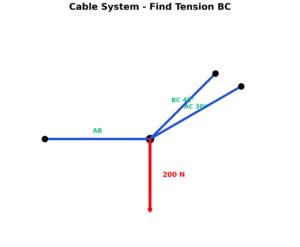
Refer to the figure. What is the tension in cable BC? (cable BC at 45° and cable AC at 30°)
 Correct
Using equilibrium at the joint, the vertical component of tension in cable BC balances the 200 N load. Since BC is at 45°, T_BC sin45° = 100 N, so T_BC = 100/0.707 = 141.4 N.
Incorrect
Using equilibrium at the joint, the vertical component of tension in cable BC balances the 200 N load. Since BC is at 45°, T_BC sin45° = 100 N, so T_BC = 100/0.707 = 141.4 N.
-
Question 25 of 30
25. Question
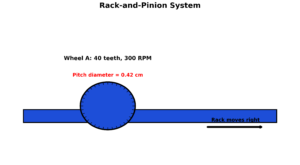
Refer to the figure. If wheel A has 40 teeth and rotates at 300 RPM and having pitch diameter 0.42 cm, what is the speed of the rack?
 Correct
Rack speed equals pinion circumference multiplied by rotational speed. From the figure, the pitch diameter is 0.42 cm, so circumference = πd ≈ 3.14 × 0.42 ≈ 1.32 cm per revolution. At 300 RPM, rack speed ≈ 1.32 × 300 = 396 cm/min = 3.96 m/min ≈ 4 m/min.
Incorrect
Rack speed equals pinion circumference multiplied by rotational speed. From the figure, the pitch diameter is 0.42 cm, so circumference = πd ≈ 3.14 × 0.42 ≈ 1.32 cm per revolution. At 300 RPM, rack speed ≈ 1.32 × 300 = 396 cm/min = 3.96 m/min ≈ 4 m/min.
-
Question 26 of 30
26. Question
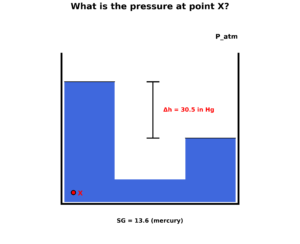
Refer to the figure. What is the pressure at point X in this U-tube manometer? (∆h=30.5 in Hg)
 Correct
In a mercury manometer, the pressure difference is found from the height difference of the fluid columns. Since the right side is open to atmosphere, the pressure at X is above atmospheric pressure by the amount corresponding to Δh = 30.5 in Hg. Because 30.5 inches of mercury is approximately equal to 15 PSI, the pressure at point X is 15 PSI.
(1 inHg≈0.491 psi , So, psi= inHg × 0.491 so, according to question, 30.5 inHg×0.491≈14.98 psi ≈ 15 psi.)Incorrect
In a mercury manometer, the pressure difference is found from the height difference of the fluid columns. Since the right side is open to atmosphere, the pressure at X is above atmospheric pressure by the amount corresponding to Δh = 30.5 in Hg. Because 30.5 inches of mercury is approximately equal to 15 PSI, the pressure at point X is 15 PSI.
(1 inHg≈0.491 psi , So, psi= inHg × 0.491 so, according to question, 30.5 inHg×0.491≈14.98 psi ≈ 15 psi.) -
Question 27 of 30
27. Question
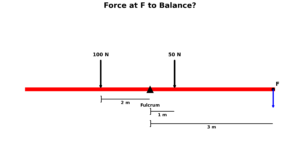
Refer to the figure having fulcrum, 100 N load at 2 m left, 50 N load at 1 m right, unknown force F at 3 m right. How much force must be applied at point F to balance the system?
 Correct
Take moments about the fulcrum. The 100 N force at 2 m gives 200 Nm, and the 50 N force at 1 m gives 50 Nm on the opposite side. The remaining 150 Nm is balanced by the force at F, so F × 3 = 150 and F = 50 N.
Incorrect
Take moments about the fulcrum. The 100 N force at 2 m gives 200 Nm, and the 50 N force at 1 m gives 50 Nm on the opposite side. The remaining 150 Nm is balanced by the force at F, so F × 3 = 150 and F = 50 N.
-
Question 28 of 30
28. Question
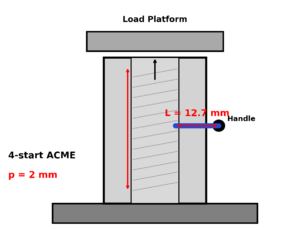
Refer to the figure. What is the mechanical advantage of this screw jack?(L= 12.7 mm)
 Correct
With L=12.7L=12.7 mm and p=2p=2 mm, the ideal mechanical advantage is about 2π(12.7)/2≈39.92π(12.7)/2≈39.9, which rounds to 40:1
Incorrect
With L=12.7L=12.7 mm and p=2p=2 mm, the ideal mechanical advantage is about 2π(12.7)/2≈39.92π(12.7)/2≈39.9, which rounds to 40:1
-
Question 29 of 30
29. Question
Water flows from a narrow pipe section into a wider pipe section. According to the continuity principle, what happens to the water’s speed in the wider section?
Correct
continuity requires the volume flow rate to remain constant; a larger cross-section means lower velocity.
Incorrect
continuity requires the volume flow rate to remain constant; a larger cross-section means lower velocity.
-
Question 30 of 30
30. Question
A hydraulic system has a small piston of 8 cm² and a large piston of 40 cm². A force of 100 N is applied to the small piston. What force does the large piston exert?
Correct
Pascal’s principle: F2 = F1 × (A2 ÷ A1) = 100 × (40 ÷ 8) = 500 N.
Incorrect
Pascal’s principle: F2 = F1 × (A2 ÷ A1) = 100 × (40 ÷ 8) = 500 N.
Next Practice Test
OAR Practice Test 5 > >