
OAR Exam Free Study Guide Unit 5: Integrated Practice and Mixed Question Sets
Integrated Practice and Mixed Question Sets are the part of OAR study guide where you put everything together.
Instead of practicing math, reading, or mechanical questions one by one, this section mixes them the way they may feel on a real test.
This is important because test day is not about solving only one type of problem. It is about switching between different question types, staying focused, and managing your time well. Mixed practice helps you build that skill step by step.
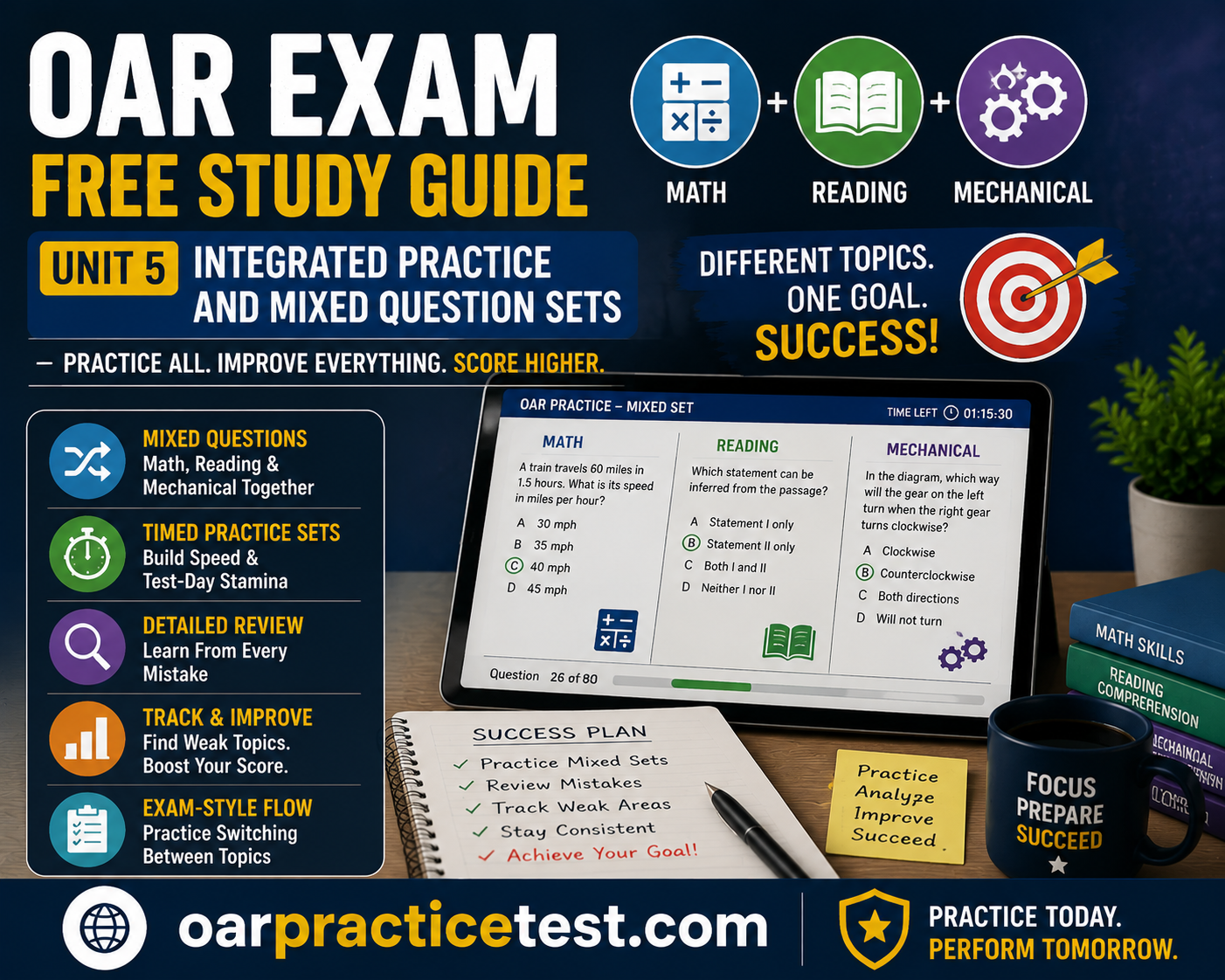
The main goal of this section is to train your brain to move smoothly from one topic to another. One question may test fractions, the next may ask for a reading inference, and the next may check a mechanical idea like force or motion. That kind of variety is what makes this practice so useful.
A good mixed practice routine also helps you find weak spots. Maybe math is fine, but reading inference still feels slow. Maybe mechanical questions are okay, but percent problems take too long. Mixed sets show you exactly where you need more review.
What This Section Includes
- Mixed math, reading, and mechanical questions.
- Short timed practice sets.
- Full review sessions after each test.
- Error tracking and score improvement.
- Practice with switching between topics quickly.
- Exam-style question flow.
How to Study It
- Start with small mixed sets before moving to longer ones.
- Use a timer so you get used to test pressure.
- Review every wrong answer carefully.
- Try to understand why the correct answer is right.
- Keep a record of your weak topics.
- Repeat mixed practice often so the test style feels familiar.
Why It Matters
This section matters because the real OAR does not give you one topic at a time. You need to stay calm and think clearly even when the questions change from one subject to another.
Mixed practice builds that mental flexibility and helps improve overall score consistency.
Quick Start Tip
If you are new to mixed practice, begin with small sets of 5 to 10 questions. After that, slowly increase the size of the set and keep reviewing your mistakes until your accuracy improvement.
Subtopic of OAR Integrated Practice and Mixed Question Sets
Integrated Practice and Mixed Question Sets are where everything comes together.
Instead of studying math, reading, and mechanical questions separately, this section helps you practice all three in a mixed format that feels much closer to the real OAR. That makes it one of the most important parts of your preparation because it trains both accuracy and test-day rhythm.
The OAR is a timed exam with about 80 questions and roughly 1.5 to 2 hours to complete, so managing speed while staying accurate is a big part of success.
Mixed practice helps you get used to switching between different question types without losing focus.
1. Why Mixed Practice Matters
What it is and why it matters
Mixed practice means you do not know what topic is coming next. One question may be about fractions, the next may ask about reading inference, and the next may test a mechanical concept like friction or levers. This is valuable because the real exam does not give you one subject at a time.
This type of practice helps you build mental flexibility. It also helps you stop depending on “topic mode” and start thinking in “test mode.”
How it helps
- It improves your ability to switch quickly between subjects.
- It makes the exam feel more familiar.
- It shows which topics are still weak.
- It builds confidence under time pressure.
Simple example
If you can solve a percent question and then immediately answer a reading inference question, you are practicing the same kind of switching that the real OAR requires.
2. Using Practice Tests Effectively
What it is and why it matters
Practice tests are not just for scoring yourself. They are also one of the best learning tools you have. A good practice test shows what you know, what you still need to review, and where you are wasting time.
The key is not only taking the test, but also reviewing it carefully afterward.
How to use them well
- Take the test in timed conditions.
- Do not stop and search for answers while testing.
- After finishing, check every mistake.
- Notice whether the problem came from content, speed, or careless reading.
What to look for
- Did you miss the concept itself?
- Did you understand the concept but rush?
- Did you misread the question?
- Did you choose the answer that looked right but was not supported?
Simple example
If you missed a geometry question because you forgot the formula, that is a content issue. If you missed it because you ran out of time, that is a pacing issue. The fix is different for each one.
3. Reviewing Mistakes the Right Way
What it is and why it matters
Reviewing mistakes is where real improvement happens. If you do not review your errors, then practice becomes repetition instead of progress. The goal is to understand why the wrong answer happened so you do not repeat it.
How to review mistakes
- Read the correct answer carefully.
- Understand the reason behind it.
- Check what trick or weakness caused the mistake.
- Write down the topic in a small error log if needed.
Types of mistakes to track
- Content mistake: you did not know the concept.
- Reading mistake: you misunderstood the question.
- Time mistake: you rushed or guessed too quickly.
- Careless mistake: you knew the answer but made a small error.
Simple example
If you chose the wrong answer on a reading question because two choices looked similar, note that you need better elimination practice.
4. Tracking Progress
What it is and why it matters
Tracking progress helps you see improvement over time. Sometimes students feel like they are not getting better, even when their scores are rising slowly. A simple record can show you what is improving and what still needs work.
How to track it
- Write down your score after each practice set.
- Record which section was strongest and weakest.
- Note the type of mistake for each wrong answer.
- Check whether your speed is improving.
What to watch
- Are you getting more questions right?
- Are you finishing faster?
- Are certain topics still causing trouble?
- Are your wrong answers happening less often?
Simple example
If your mechanical score stays weak but your math score improves, that tells you where to focus next. Progress is easier to manage when you can see it clearly.
5. Building Speed and Accuracy
What it is and why it matters
The OAR rewards both speed and accuracy. You cannot spend too long on one problem, but you also cannot rush and make sloppy mistakes. Mixed practice helps you learn the right balance.
How to improve both
- Start with untimed practice to learn the concepts.
- Move to timed small sets.
- Then practice larger mixed sets under real exam timing.
- Learn when to move on from a difficult question.
Good habits
- Answer easy questions first when possible.
- Do not get stuck on one hard problem.
- Use elimination to narrow down choices.
- Stay calm when the topic changes.
Simple example
If a question feels too slow, it may be better to make your best guess and move on instead of wasting valuable time.
6. Question Switching and Mental Flexibility
What it is and why it matters
One of the hardest parts of the OAR is not just the questions themselves, but the switching between them. You may go from math to reading to mechanical reasoning very quickly. That can feel tiring if you are not used to it.
This is why mixed practice is so useful. It trains your mind to reset fast.
How to improve switching
- Practice in mixed sets, not only one-topic drills.
- Learn to “start fresh” on each question.
- Read the question carefully before trying to solve it.
- Avoid carrying frustration from one question into the next.
Simple example
If you miss a math problem, do not let it affect your reading question right after it. Every new question deserves a fresh start.
7. Full Practice Sets
What it is and why it matters
Full practice sets are longer mixed tests that copy the feel of the actual exam as closely as possible. These are especially useful once you already know the basics and want to build endurance.
Full sets help you practice the whole process: pacing, focus, switching, and review.
How to use full sets
- Take them seriously and time yourself.
- Avoid interruptions while testing.
- Review the results after the test.
- Use the results to decide what to study next.
What they teach you
- How long your focus stays strong.
- Which question types slow you down.
- Whether your accuracy drops when you get tired.
- How well you handle pressure.
Simple example
A full practice set may show that you start strong in math but lose focus in the later mechanical questions. That tells you that endurance needs work.
8. Study Plans Using Mixed Practice
What it is and why it matters
A good OAR study plan should include both topic-based review and mixed practice. If you only study one topic at a time, the exam may still feel unfamiliar. Mixed practice brings everything together.
A simple plan
- Start with one-topic learning.
- After that, do small mixed sets.
- Later, do longer timed sets.
- Finish with full practice tests and review.
Why this works
This method helps you learn the material and then apply it under exam conditions. That is the best way to prepare for a timed test like the OAR.
Simple example
You might study fractions on Monday, reading inference on Tuesday, and mechanical force on Wednesday. Then on Thursday, do a mixed set that includes all three.
9. Common Mistakes in Mixed Practice
What it is and why it matters
Mixed practice can be very helpful, but only if you use it correctly. Some students rush through it or treat it like a game score. That wastes the value of the exercise.
Common mistakes
- Skipping review after the test.
- Focusing only on the score and not the errors.
- Doing mixed sets too early before learning the basics.
- Not using a timer.
- Staying only in strong subjects and avoiding weak ones.
Simple example
If you keep doing mixed practice but never review your wrong answers, you may keep making the same mistakes again and again.
10. Best Strategy for This Section
A simple method
- Learn the topic first.
- Practice it in small sets.
- Mix topics together.
- Review every mistake.
- Track your progress.
- Take full timed practice tests.
Why this works
This strategy builds both knowledge and test performance. It helps you move from “I know the topic” to “I can solve it under pressure.”
Good habit to build
Always ask, “What did this practice set teach me?” That question turns every test into a learning tool.
11. Quick Study Routine
A simple routine for mixed practice can look like this:
- 10 to 15 minutes of review on one weak topic.
- 15 to 20 mixed questions under a timer.
- 10 minutes of answer review.
- A small note of mistakes and weak areas.
This routine is simple, but it works well if you repeat it consistently.
12. Short Practice Example
Example idea:
A mixed set includes:
- a percent problem,
- a reading inference question,
- a question about pulleys,
- and a question about main idea.
This is useful because it forces the brain to switch between math, reading, and mechanical reasoning just like the real OAR.