
OAR Exam Free Study Guide Unit 1: OAR Exam Basics & Study Strategy
The Officer Aptitude Rating (OAR) is a computer‑based exam used within the ASTB‑E battery to evaluate core academic and problem‑solving skills for Navy, Marine Corps, and Coast Guard officer candidates.
It has three main parts—Math Skills, Reading Comprehension, and Mechanical Comprehension—and together they show how well you can solve problems and understand information, especially for technical and aviation‑related jobs.
To get a good score, you should first learn what each part of the test looks like, then follow a simple study plan: practice lots of questions, use timed practice to improve your speed, and always check your mistakes so you keep getting better over time.
There are 4 section you need to understand before start OAR Exam preparation.
- What the OAR Exam Basics Measures
- OAR Test Format and Timing
- Scoring and Performance Goals
- Scoring and Performance Goals
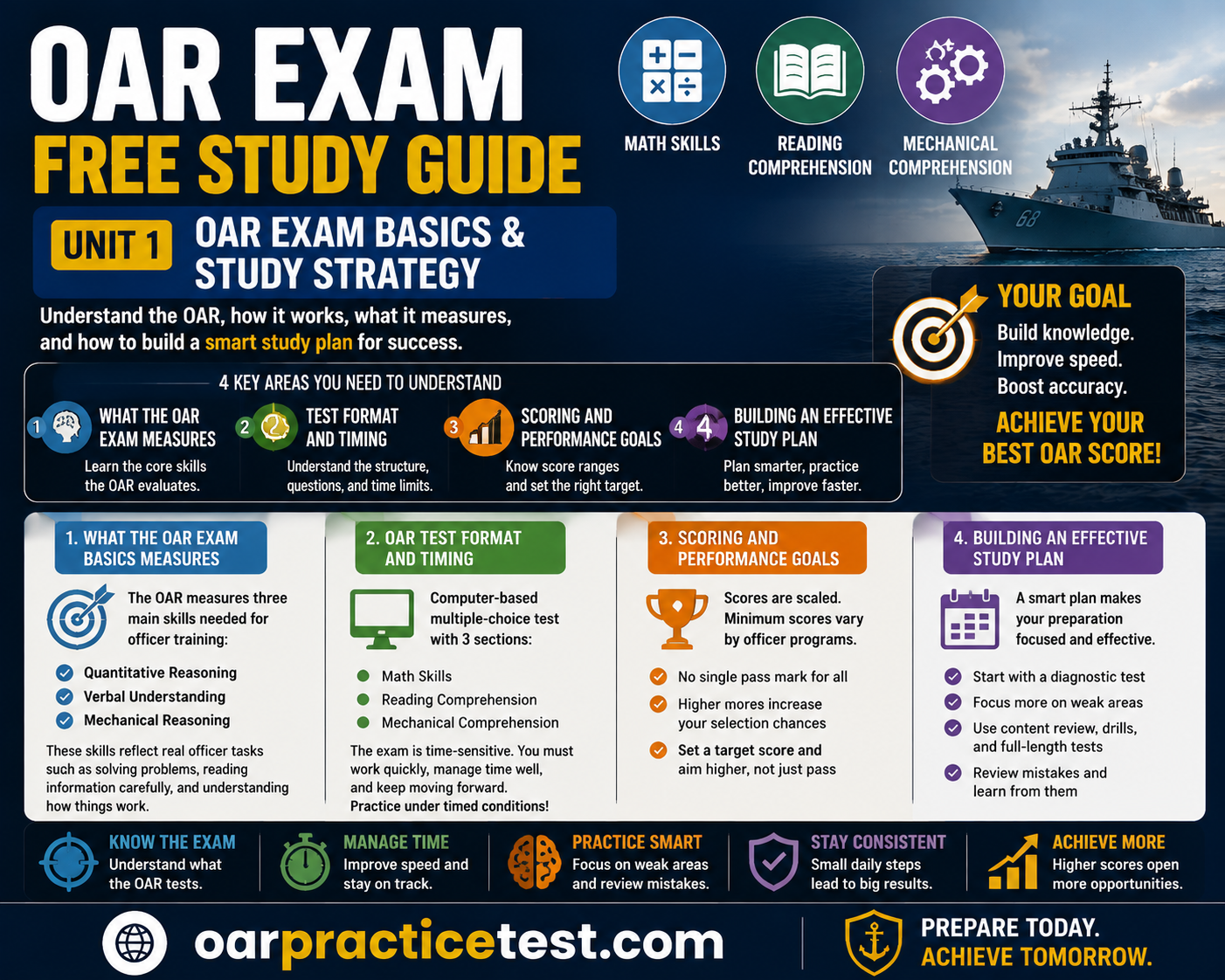
1.1 What the OAR Exam Basics Measures
The Officer Aptitude Rating, or OAR, is meant to check whether a candidate has the basic academic and problem-solving skills needed for officer training.
It is especially important for technical and aviation-related careers, where quick thinking, understanding instructions, and solving problems correctly really matter.
The test focuses on three main skill areas: quantitative reasoning, verbal understanding, and mechanical reasoning. These are not just school subjects; they reflect how well a person can handle real officer-style tasks such as reading information carefully, doing calculations, and understanding how things work.
The OAR is part of the larger ASTB-E test system, which also includes other subtests used for aviation and related scoring purposes. That means the OAR is not a general IQ test or a simple classroom exam — it is closely connected to military selection and officer preparation.
1.2 OAR Test Format and Timing
The OAR is taken on a computer and is made up of multiple-choice questions. The three sections are Math Skills, Reading Comprehension, and Mechanical Comprehension, and together they form the OAR score.
The exact number of questions and time limit can depend on the version or testing setup, but the exam is always considered time-sensitive. In practice, candidates need to work quickly and avoid spending too much time on one difficult question.
This is why time management is a big part of OAR preparation. You should learn how to solve easier questions fast, mark harder ones mentally, and move on before losing valuable time. A strong strategy is to practise under timed conditions so that the real exam feels familiar instead of stressful.
1.3 OAR Scoring and Performance Goals
OAR scores are usually shown on a scaled range, and different officer programs may ask for different minimum scores. In other words, there is not always one single “pass mark” for everyone.
A higher score can make your application more competitive, especially for programs where many candidates apply and only a limited number are selected. For that reason, your goal should not just be to pass, but to reach a score that gives you a better chance of selection.
Many prep guides suggest setting a target score first and then building your study plan around that goal. For example, if your desired officer path needs a stronger score, you should spend more time strengthening your weakest section instead of studying everything equally.
1.4 Building an Effective OAR Study Plan
A good study plan usually starts with a diagnostic or practice test. This helps you see where you are already strong and where you are losing points.
After that, you should divide your study time across the major topic areas and give extra attention to the weaker ones. For example, if math is weak but reading is decent, then your plan should spend more hours on algebra, percentages, geometry, and word problems.
The best study plans mix content review, short problem-solving drills, and full-length timed practice tests. Just doing random questions is not enough — you also need to review mistakes, understand why the answer was wrong, and repeat the topic until it improves.