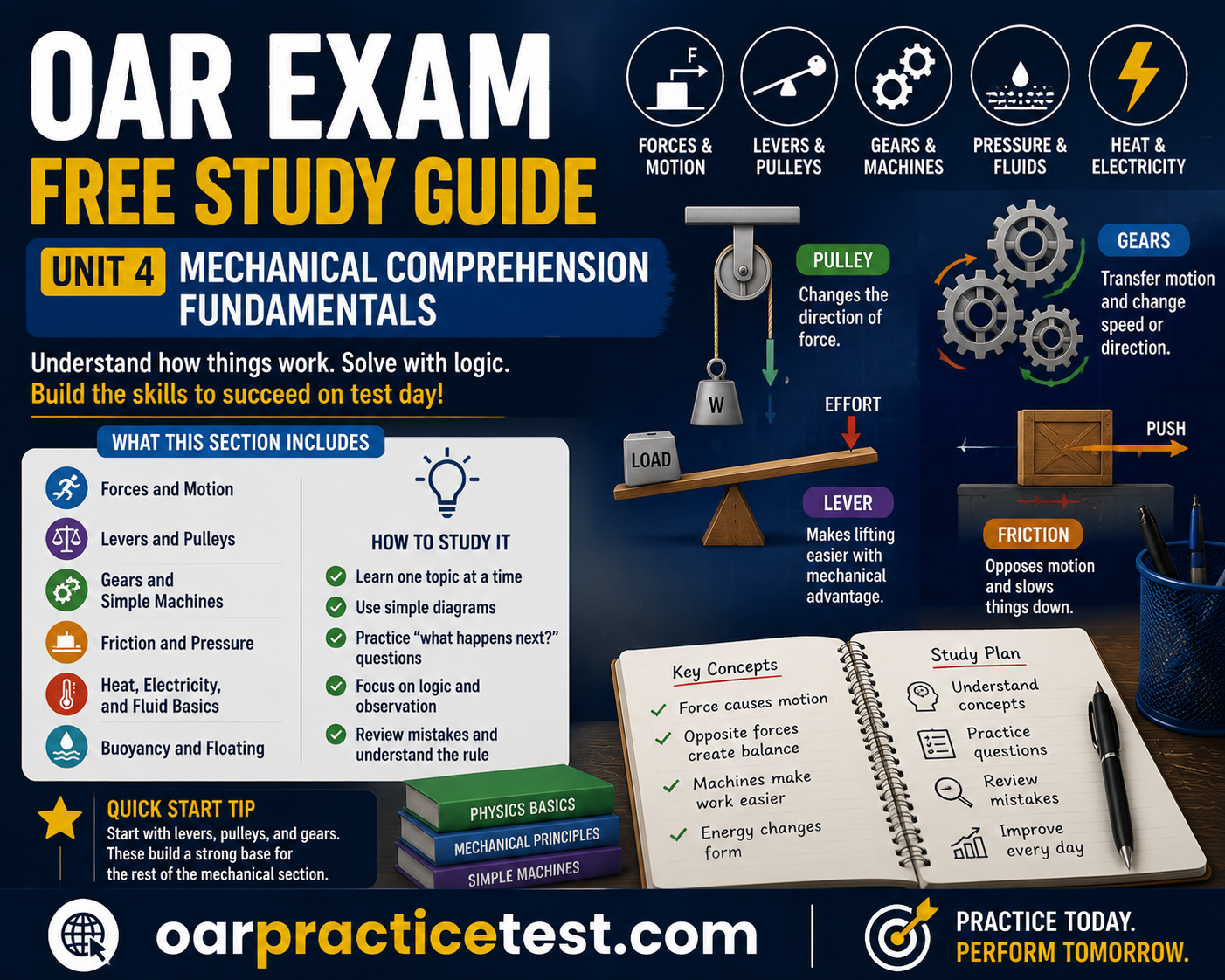
OAR Exam Free Study Guide Unit 4 : Mechanical Comprehension Fundamentals
The OAR Mechanical Comprehension section checks how well you understand basic physics, motion, forces, tools, and simple machines.
It is designed to see whether you can look at a picture, a situation, or a machine and figure out what will happen.
This section is important because many officer roles involve practical thinking, technical systems, and problem-solving.
You do not need advanced engineering knowledge, but you do need a clear understanding of how everyday mechanical ideas .
The questions often cover topics like levers, pulleys, gears, friction, pressure, speed, and force. Some questions are visual, while others are short situations that ask you to predict motion, balance, or mechanical advantage.
A good way to prepare is to learn the basic idea behind each topic, practice with diagrams, and focus on understanding cause and effect.
If you can see why a machine works the way it does, you will do much better on this section.
What This Section Includes
Forces and motion.
Levers and pulleys.
Gears and simple machines.
Friction and pressure.
Heat, electricity, and fluid basics.
Buoyancy and floating.
How to Study It
Learn one topic at a time.
Use simple diagrams to understand movement.
Practice questions that ask “what happens next?”
Focus on logic and observation.
Review mistakes to understand the physical rule behind them.
Why It Matters
Strong mechanical understanding helps you solve practical problems quickly and accurately. On the OAR, this section shows whether you can think clearly about how machines and systems behave in real life.
Quick Start Tip
If you are new to this section, begin with levers, pulleys, and gears first. These are the easiest topics to understand and they build a strong base for the rest of the mechanical section.
Subtopic of OAR Mechanical Section
4.1 Forces and Motion
What it is and why it matters
Forces and motion are the starting point for many mechanical questions. A force is a push or pull. Motion is the way an object moves after a force acts on it.
The OAR often asks you to compare objects, predict direction, or decide what changes when force increases or decreases.
This topic matters because almost every mechanical question is based on some kind of movement. If you understand force and motion, many other topics become easier too.
How to think about it
A bigger push usually causes more movement.
If no force acts on an object, it keeps doing what it is already doing.
Friction can slow movement down.
Direction matters just as much as strength.
Common question patterns
Which object moves faster?
What happens when force is increased?
In which direction will the object move?
Simple example
If you push two boxes with the same effort but one box is heavier, the lighter box will usually move more easily. The heavier box needs more force to change its motion.
4.2 Newton’s Laws
What it is and why it matters
Newton’s laws explain how objects behave when forces act on them. These ideas show up often in mechanical questions because they help explain why things stay still, speed up, or push back.
You do not need advanced physics to do well here. You just need the basic meaning of each law.
The three laws in simple words
First law: An object stays at rest or keeps moving the same way unless a force changes it.
Second law: More force usually means more acceleration.
Third law: Every action has an equal and opposite reaction.
How to think about it
If nothing is pushing or pulling, motion stays the same.
If force increases, acceleration usually increases too.
When one object pushes another, the second object pushes back with equal force.
Common question patterns
What happens if force is removed?
Why does a heavier object need more force?
Which example shows action and reaction?
Simple example
If a person pushes on a wall, the wall pushes back on the person. Even if the wall does not move, the reaction force still exists.
4.3 Speed, Velocity, and Acceleration
What it is and why it matters
These words describe motion in different ways. Speed tells how fast something moves. Velocity tells how fast and in what direction. Acceleration tells how quickly motion changes.
These ideas often appear in questions about moving vehicles, falling objects, or objects changing direction.
How to think about it
Speed is distance over time.
Velocity includes direction.
Acceleration means speeding up, slowing down, or changing direction.
Common question patterns
Which object has greater speed?
What counts as acceleration?
What happens when a car turns?
Simple example
A car driving straight at a steady speed has speed but no acceleration. If it starts speeding up, it is accelerating.
4.4 Work, Energy, and Power
What it is and why it matters
Work happens when a force moves something. Energy is the ability to do work. Power tells how quickly work is done. These ideas are useful when the question involves lifting, moving, or operating a machine.
They are important because many mechanical systems are designed to save effort or do work faster.
How to think about it
More force over a longer distance means more work.
Energy can change form, like from stored energy to motion.
Power is about speed of work, not just amount of work.
Common question patterns
Which machine does work faster?
What object has more stored energy?
What happens when height increases?
Simple example
A box lifted higher has more potential energy than the same box resting on the floor.
4.5 Levers
What it is and why it matters
A lever is a simple machine that helps move or lift a load with less effort. It works around a pivot point called the fulcrum.
Levers are a big part of mechanical comprehension because they clearly show how force and distance are related.
How to think about it
A lever has three main parts: fulcrum, load, and effort.
The farther the effort is from the fulcrum, the easier it is to lift the load.
The closer the load is to the fulcrum, the easier the job becomes.
Common question patterns
Where should the effort be applied?
Which setup gives better mechanical advantage?
Which side moves farther?
Simple example
A longer wrench makes it easier to loosen a bolt because it gives you more turning force.
4.6 Pulleys
What it is and why it matters
Pulleys help lift or move objects by changing the direction of force or reducing the effort needed. They are often used in cranes, elevators, and lifting systems.
This topic is common because pulley systems are easy to test with pictures and motion questions.
How to think about it
A fixed pulley changes the direction of the pull.
A movable pulley can reduce the force needed.
More rope sections supporting the load usually means less effort is needed.
Common question patterns
Which pulley system needs less force?
How does the load move when the rope is pulled?
How many rope sections support the object?
Simple example
If a pulley system has more strands holding the load, the lift becomes easier, but you may have to pull more rope.
4.7 Gears and Rotational Motion
What it is and why it matters
Gears transfer motion from one part of a machine to another. They can change speed, direction, and force.
This is a common OAR topic because gear questions are often visual and require simple logic rather than heavy calculation.
How to think about it
When one gear turns, the gear touching it usually turns the opposite way.
Larger gears often turn more slowly but with more force.
Smaller gears usually turn faster but with less force.
Common question patterns
Which direction does the gear turn?
Which gear turns faster?
What happens when gear size changes?
Simple example
If a small gear drives a large gear, the large gear turns more slowly. If a large gear drives a small gear, the small gear turns more quickly.
4.8 Inclined Planes, Wedges, and Screws
What it is and why it matters
These are all simple machines that make work easier in different ways. An inclined plane is a ramp, a wedge is like a knife, and a screw is like a ramp wrapped around a cylinder.
These ideas matter because they show how force can be spread over distance to make a job easier.
How to think about it
An inclined plane reduces the force needed to lift something.
A wedge helps cut, split, or separate objects.
A screw helps hold things together or lift materials.
Common question patterns
Which ramp needs less force?
Why does a sharp wedge work better?
How does a screw help?
Simple example
A longer ramp makes it easier to push a heavy object upward, even though the object has to travel farther.
4.9 Friction
What it is and why it matters
Friction is the force that resists motion when two surfaces touch. It can help movement in some situations and make movement harder in others.
This topic appears often because friction affects almost everything that moves on a surface.
How to think about it
Rough surfaces usually create more friction.
Smooth surfaces usually create less friction.
Friction can help you walk, but it can also slow down objects.
Common question patterns
Which surface has more friction?
What happens when friction increases?
Why does an object stop moving?
Simple example
A box is easier to push on ice than on sandpaper because ice creates less friction.
4.10 Pressure and Fluids
What it is and why it matters
Pressure is force spread over an area. Fluids include liquids and gases. These questions often ask how pressure changes when area, force, or depth changes.
This topic matters because pressure is used in many real machines and also explains common everyday situations.
How to think about it
More force on the same area creates more pressure.
The same force on a smaller area creates more pressure.
In fluids, pressure increases as depth increases.
Common question patterns
Why does a sharp knife cut better?
Which object creates more pressure?
What happens deeper under water?
Simple example
A person wearing high heels creates more pressure on the floor than a person wearing flat shoes because the force is concentrated on a smaller area.
4.11 Hydraulics and Pneumatics
What it is and why it matters
Hydraulic systems use liquids, and pneumatic systems use gases. These systems transfer force and are used in brakes, lifts, and machinery.
The OAR may test the basic idea that a fluid system can help move a larger load with less effort.
How to think about it
Pressure in a closed fluid can move through the system.
A small force can become a larger force.
These systems make heavy work easier.
Common question patterns
Which piston creates more force?
How does a hydraulic system help?
Why are fluid systems useful?
Simple example
A hydraulic jack can lift a car because the force applied to the fluid is transferred and multiplied in the system.
4.12 Heat, Temperature, and Expansion
What it is and why it matters
Heat is energy that moves from one object to another. Temperature tells how hot or cold something is. Most materials expand when heated and shrink when cooled.
This topic may appear in questions about metal parts, machinery, or real-world engineering situations.
How to think about it
Heating usually makes materials expand.
Cooling usually makes materials contract.
Different materials may expand at different rates.
Common question patterns
What happens to metal when heated?
Why do bridges have gaps?
What changes when temperature rises?
Simple example
Railroad tracks need spaces between sections because metal expands when it gets hot.
4.13 Electricity Basics
What it is and why it matters
Some mechanical questions include basic electricity. You do not need advanced electrical theory, but you should know the simple ideas of circuits, current, switches, conductors, and insulators.
This helps because many machines and systems depend on electricity to work.
How to think about it
A circuit must be complete for current to flow.
A switch opens or closes a circuit.
Conductors allow current to flow more easily than insulators.
Common question patterns
What happens when a switch is open?
Which material is a conductor?
Why does a bulb stop working?
Simple example
If a circuit is broken, electricity cannot flow and the bulb will not light.
4.14 Buoyancy and Floating
What it is and why it matters
Buoyancy is the force that allows objects to float in a fluid. These questions ask why some things sink and others float.
This topic is useful because it combines force, density, and fluid behavior in a simple way.
How to think about it
Objects less dense than the fluid tend to float.
Objects more dense than the fluid tend to sink.
Shape can also affect floating.
Common question patterns
Why does a ship float?
What happens when density increases?
Which object sinks faster?
Simple example
A big steel ship can float because its shape helps it displace enough water to stay up.
4.15 Strategy for Mechanical Questions
A simple method
Look at the picture or situation carefully.
Identify the machine, force, or motion involved.
Decide what is changing.
Compare the answer choices.
Pick the choice that matches the rule best.
Why this works
Mechanical questions often look more difficult than they really are. Once you know the basic principle, the answer becomes much easier to choose.
Good habit to build
Always ask, “What is this machine or force doing?” That question helps you focus on the real problem.
4.16 Quick Study Routine
A simple study routine for mechanical comprehension can look like this:
Review one topic at a time.
Draw basic diagrams for levers, pulleys, and gears.
Practice timed questions.
Focus on understanding the concept, not just memorizing.
Review wrong answers and learn why they were wrong.
Even short daily practice can improve confidence and accuracy.
4.17 Short Practice Example
Example idea: A worker uses a longer wrench to loosen a bolt. Another worker uses a short wrench.
Possible questions:
Which wrench gives more force advantage?
Why does the longer wrench help?
What simple machine is being used?
This type of question can test levers, force, and mechanical advantage at the same time.
OAR Mechanical Comprehension Practice Test
OAR Mechanical Comprehension Practice Test is designed to help you strengthen the core mechanical comprehension skills needed for the OAR exam, including force and motion, pressure, simple machines, gears and pulleys, and basic mechanical principles. This focused practice test gives you a clear way to assess your preparation, improve speed and accuracy, and build confidence before the exam.
Time limit: 0
Quiz-summary
0 of 20 questions completed
Questions:
1
2
3
4
5
6
7
8
9
10
11
12
13
14
15
16
17
18
19
20
Information
Test Instructions No. of Questions: 20 Questions: Multiple choice with 4 options (A, B, C, D) Review: You can flag questions for review and return to them Submission: Click “Submit Test” when ready to finish.
You have already completed the quiz before. Hence you can not start it again.
Quiz is loading...
You must sign in or sign up to start the quiz.
You have to finish following quiz, to start this quiz:
Results
0 of 20 questions answered correctly
Your time:
Time has elapsed
You have reached 0 of 0 points, (0)
Categories
Not categorized0%
1
2
3
4
5
6
7
8
9
10
11
12
13
14
15
16
17
18
19
20
Answered
Review
Question 1 of 20
1. Question
A compound gear train has Gear 1 (60 teeth, 20 RPM) meshing with Gear 2 (20 teeth). Gears 2 and 3 share the same shaft; Gear 3 has 40 teeth and meshes with Gear 4 (10 teeth). What is Gear 4’s rotational speed?
A class-3 lever (effort between fulcrum and load) has the load of 150 N located 1.2 m from the fulcrum and the effort applied 0.8 m from the fulcrum. What effort force is required?
Correct
ALL lever types use the same moment (torque) balance: Effort × effort arm = Load × load arm A class-3 lever has the EFFORT between the fulcrum and load — it has a mechanical DISADVANTAGE (effort > load), but provides speed and range of motion. therefore: Effort × 0.8 = 150 × 1.2 Effort × 0.8 = 180 Effort = 180 ÷ 0.8 = 225 N
Incorrect
ALL lever types use the same moment (torque) balance: Effort × effort arm = Load × load arm A class-3 lever has the EFFORT between the fulcrum and load — it has a mechanical DISADVANTAGE (effort > load), but provides speed and range of motion. therefore: Effort × 0.8 = 150 × 1.2 Effort × 0.8 = 180 Effort = 180 ÷ 0.8 = 225 N
Question 3 of 20
3. Question
A pulley system has a mechanical advantage of 4 but an efficiency of 75 % due to friction. What input force is required to lift a 480 N load?
Correct
EFFICIENCY accounts for energy lost to friction. It is defined as: Efficiency = Ideal effort ÷ Actual effort => Actual effort = Ideal effort ÷ Efficiency. therefore: Ideal (frictionless) input force = Load ÷ MA = 480 ÷ 4 = 120 N. So, Actual input force = Ideal ÷ Efficiency = 120 ÷ 0.75 = 160 N
Incorrect
EFFICIENCY accounts for energy lost to friction. It is defined as: Efficiency = Ideal effort ÷ Actual effort => Actual effort = Ideal effort ÷ Efficiency. therefore: Ideal (frictionless) input force = Load ÷ MA = 480 ÷ 4 = 120 N. So, Actual input force = Ideal ÷ Efficiency = 120 ÷ 0.75 = 160 N
Question 4 of 20
4. Question
A hydraulic cylinder piston has an area of 0.08 m². The fluid pressure acting on it is 250 000 Pa. What force does the piston exert?
Correct
PRESSURE is defined as Force per unit Area: P = F ÷ A => Force = Pressure × Area. So, here: P = 250 000 Pa = 250 000 N/m², A = 0.08 m². therefore: F = P × A = 250 000 × 0.08 = 20 000 N
Incorrect
PRESSURE is defined as Force per unit Area: P = F ÷ A => Force = Pressure × Area. So, here: P = 250 000 Pa = 250 000 N/m², A = 0.08 m². therefore: F = P × A = 250 000 × 0.08 = 20 000 N
Question 5 of 20
5. Question
A 12 V battery connects to a circuit where R₁ = 6 Ω is in series with a parallel combination of R₂ = 4 Ω and R₃ = 12 Ω. What is the total current flowing through R₁?
Correct
Step 1 — R₂ ∥ R₃: 1/R_parallel = 1/4 + 1/12 = 3/12 + 1/12 = 4/12 R_parallel = 12/4 = 3 Ω.
Step 2 — Total resistance: R_total = R₁ + R_parallel = 6 + 3 = 9 Ω.
Step 3 — Total current (through R₁, which carries ALL current): I = V ÷ R_total = 12 ÷ 9 = 4/3 ≈ 1.33 A
Incorrect
Step 1 — R₂ ∥ R₃: 1/R_parallel = 1/4 + 1/12 = 3/12 + 1/12 = 4/12 R_parallel = 12/4 = 3 Ω.
Step 2 — Total resistance: R_total = R₁ + R_parallel = 6 + 3 = 9 Ω.
Step 3 — Total current (through R₁, which carries ALL current): I = V ÷ R_total = 12 ÷ 9 = 4/3 ≈ 1.33 A
Question 6 of 20
6. Question
A 500 N crate is pushed up a ramp 5 m long that rises 3 m (a 3-4-5 triangle). The coefficient of kinetic friction is 0.25. What force is required to push the crate up the ramp at constant speed?
Correct
On an inclined plane with friction, the required force must overcome BOTH the gravitational component along the slope AND kinetic friction. GEOMETRY (3-4-5 triangle): sin θ = 3/5 = 0.60 (rise/ramp length) cos θ = 4/5 = 0.80 (base/ramp length). So, Component of weight along slope = W sin θ = 500 × 0.60 = 300 N Normal force = W cos θ = 500 × 0.80 = 400 N Friction force = μ × N = 0.25 × 400 = 100 N At constant speed (no acceleration). therefore: net force = 0: F_push = Force along slope + Friction = 300 + 100 = 400 N
Incorrect
On an inclined plane with friction, the required force must overcome BOTH the gravitational component along the slope AND kinetic friction. GEOMETRY (3-4-5 triangle): sin θ = 3/5 = 0.60 (rise/ramp length) cos θ = 4/5 = 0.80 (base/ramp length). So, Component of weight along slope = W sin θ = 500 × 0.60 = 300 N Normal force = W cos θ = 500 × 0.80 = 400 N Friction force = μ × N = 0.25 × 400 = 100 N At constant speed (no acceleration). therefore: net force = 0: F_push = Force along slope + Friction = 300 + 100 = 400 N
Question 7 of 20
7. Question
A bolt requires 90 N·m of torque to loosen. A mechanic can apply a maximum force of 75 N. What is the minimum wrench length needed?
Correct
TORQUE = Force × perpendicular distance (lever arm length) Rearranged for distance: d = Torque ÷ Force STEP-BY-STEP: Torque needed = 90 N·m Maximum force = 75 N Minimum wrench length = 90 ÷ 75 = 1.2 m
Incorrect
TORQUE = Force × perpendicular distance (lever arm length) Rearranged for distance: d = Torque ÷ Force STEP-BY-STEP: Torque needed = 90 N·m Maximum force = 75 N Minimum wrench length = 90 ÷ 75 = 1.2 m
Question 8 of 20
8. Question
Water flows horizontally through a pipe at 200 000 Pa pressure and a speed of 2 m/s. The pipe narrows and the speed increases to 8 m/s. Using Bernoulli’s equation (ρ = 1 000 kg/m³), what is the pressure in the narrow section?
Correct
BERNOULLI’S EQUATION (horizontal flow): P + ½ρv² = constant Where P = pressure, ρ = fluid density, v = velocity. As speed INCREASES, pressure DECREASES (pressure energy converts to kinetic energy). therefore: P₁ + ½ρv₁² = P₂ + ½ρv₂² => 200 000 + ½(1000)(2²) = P₂ + ½(1000)(8²) => 200 000 + 2 000 = P₂ + 32 000 => 202 000 = P₂ + 32 000 => P₂ = 202 000 − 32 000 = 170 000 Pa
Incorrect
BERNOULLI’S EQUATION (horizontal flow): P + ½ρv² = constant Where P = pressure, ρ = fluid density, v = velocity. As speed INCREASES, pressure DECREASES (pressure energy converts to kinetic energy). therefore: P₁ + ½ρv₁² = P₂ + ½ρv₂² => 200 000 + ½(1000)(2²) = P₂ + ½(1000)(8²) => 200 000 + 2 000 = P₂ + 32 000 => 202 000 = P₂ + 32 000 => P₂ = 202 000 − 32 000 = 170 000 Pa
Question 9 of 20
9. Question
Two springs are connected in series: Spring 1 has k₁ = 300 N/m and Spring 2 has k₂ = 600 N/m. What is the effective spring constant of the combination?
Correct
FORMULA for springs in series: 1/k_eff = 1/k₁ + 1/k₂. So, as per data: 1/k_eff = 1/300 + 1/600 => Common denominator of 600: = 2/600 + 1/600 = 3/600 => k_eff = 600 ÷ 3 = 200 N/m
Incorrect
FORMULA for springs in series: 1/k_eff = 1/k₁ + 1/k₂. So, as per data: 1/k_eff = 1/300 + 1/600 => Common denominator of 600: = 2/600 + 1/600 = 3/600 => k_eff = 600 ÷ 3 = 200 N/m
Question 10 of 20
10. Question
Three objects lie on a straight line: 3 kg at x = 0 m, 5 kg at x = 4 m, and 2 kg at x = 7 m. What is the x-coordinate of the system’s center of mass?
Correct
CENTER OF MASS (CM) for a system of point masses on a line: x_CM = (m₁x₁ + m₂x₂ + m₃x₃) ÷ (m₁ + m₂ + m₃) So ,as per data: Numerator: (3×0) + (5×4) + (2×7) = 0 + 20 + 14 = 34 kg·m , Total mass: 3 + 5 + 2 = 10 kg. therefore: x_CM = 34 ÷ 10 = 3.4 m
Incorrect
CENTER OF MASS (CM) for a system of point masses on a line: x_CM = (m₁x₁ + m₂x₂ + m₃x₃) ÷ (m₁ + m₂ + m₃) So ,as per data: Numerator: (3×0) + (5×4) + (2×7) = 0 + 20 + 14 = 34 kg·m , Total mass: 3 + 5 + 2 = 10 kg. therefore: x_CM = 34 ÷ 10 = 3.4 m
Question 11 of 20
11. Question
A diver at 10 m depth (where absolute pressure = 2 atm) exhales an air bubble of volume 0.5 L. Assuming the temperature remains constant, what is the bubble’s volume when it reaches the surface (1 atm)?
Correct
BOYLE’S LAW: At constant temperature, pressure and volume of a gas are inversely proportional. FORMULA: P₁V₁ = P₂V₂. So, as per question: P₁ = 2 atm (at 10 m depth), V₁ = 0.5 L (bubble at depth), P₂ = 1 atm (at surface), V₂ = ?. therefore: 2 × 0.5 = 1 × V₂ => V₂ = 1.0 L
Incorrect
BOYLE’S LAW: At constant temperature, pressure and volume of a gas are inversely proportional. FORMULA: P₁V₁ = P₂V₂. So, as per question: P₁ = 2 atm (at 10 m depth), V₁ = 0.5 L (bubble at depth), P₂ = 1 atm (at surface), V₂ = ?. therefore: 2 × 0.5 = 1 × V₂ => V₂ = 1.0 L
Question 12 of 20
12. Question
A pump delivers water at a volume flow rate of 0.12 m³/s through a pipe with a cross-sectional area of 0.04 m². What is the flow speed in the pipe?
Correct
VOLUME FLOW RATE (Q) is the volume of fluid passing a cross-section per second: Q = A × v , Where A = cross-sectional area and v = flow velocity. => v = Q ÷ A. So, as per data: Q = 0.12 m³/s , A = 0.04 m². therefore: v = 0.12 ÷ 0.04 = 3.0 m/s
Incorrect
VOLUME FLOW RATE (Q) is the volume of fluid passing a cross-section per second: Q = A × v , Where A = cross-sectional area and v = flow velocity. => v = Q ÷ A. So, as per data: Q = 0.12 m³/s , A = 0.04 m². therefore: v = 0.12 ÷ 0.04 = 3.0 m/s
Question 13 of 20
13. Question
A compound machine consists of a lever with mechanical advantage 4 connected to a pulley system with mechanical advantage 3. What is the overall mechanical advantage of the compound machine?
Correct
When simple machines are combined in a COMPOUND machine, the overall mechanical advantage is the PRODUCT of the individual mechanical advantages: MA_total = MA₁ × MA₂ × … × MAₙ. so, as per data: MA_lever = 4, MA_pulley = 3. therefore: MA_total = 4 × 3 = 12
Incorrect
When simple machines are combined in a COMPOUND machine, the overall mechanical advantage is the PRODUCT of the individual mechanical advantages: MA_total = MA₁ × MA₂ × … × MAₙ. so, as per data: MA_lever = 4, MA_pulley = 3. therefore: MA_total = 4 × 3 = 12
Question 14 of 20
14. Question
An object weighs 50 N in air and 32 N when fully submerged in fresh water (density 1 000 kg/m³, g = 10 m/s²). What is the object’s volume?
Correct
The apparent weight loss when submerged equals the BUOYANT FORCE, which equals the weight of displaced fluid. Buoyant force = ρ_fluid × V × g => V = Buoyant force ÷ (ρ × g). So, Buoyant force = Weight in air − Weight in water = 50 − 32 = 18 N. therefore: V = 18 ÷ (1 000 × 10) = 18 ÷ 10 000 = 0.0018 m³
Incorrect
The apparent weight loss when submerged equals the BUOYANT FORCE, which equals the weight of displaced fluid. Buoyant force = ρ_fluid × V × g => V = Buoyant force ÷ (ρ × g). So, Buoyant force = Weight in air − Weight in water = 50 − 32 = 18 N. therefore: V = 18 ÷ (1 000 × 10) = 18 ÷ 10 000 = 0.0018 m³
Question 15 of 20
15. Question
A pendulum bob of mass 0.5 kg is released from a height of 0.8 m above its lowest point. What is its maximum speed at the lowest point? (Use g = 10 m/s²)
Correct
CONSERVATION OF MECHANICAL ENERGY in an ideal (frictionless) pendulum: All potential energy at the top converts entirely to kinetic energy at the bottom. therefore: mgh = ½mv² => The mass m cancels from both sides => gh = ½v² => v² = 2gh = 2 × 10 × 0.8 = 16 => v = √16 = 4 m/s
Incorrect
CONSERVATION OF MECHANICAL ENERGY in an ideal (frictionless) pendulum: All potential energy at the top converts entirely to kinetic energy at the bottom. therefore: mgh = ½mv² => The mass m cancels from both sides => gh = ½v² => v² = 2gh = 2 × 10 × 0.8 = 16 => v = √16 = 4 m/s
Question 16 of 20
16. Question
Pulley A (radius 20 cm) drives Pulley B (radius 5 cm) via belt. Pulleys B and C share a shaft; Pulley C (radius 15 cm) drives Pulley D (radius 5 cm) via a second belt. If A rotates at 30 RPM, what is D’s speed?
Correct
Stage 1 — A drives B: Speed of B = 30 × (r_A ÷ r_B) = 30 × (20 ÷ 5) = 30 × 4 = 120 RPM , B and C share a shaft → Speed of C = 120 RPM.
Stage 2 — C drives D: Speed of D = 120 × (r_C ÷ r_D) = 120 × (15 ÷ 5) = 120 × 3 = 360 RPM ,OVERALL RATIO (A to D) = 4 × 3 = 12 => D’s speed = 30 × 12 = 360 RPM
Incorrect
Stage 1 — A drives B: Speed of B = 30 × (r_A ÷ r_B) = 30 × (20 ÷ 5) = 30 × 4 = 120 RPM , B and C share a shaft → Speed of C = 120 RPM.
Stage 2 — C drives D: Speed of D = 120 × (r_C ÷ r_D) = 120 × (15 ÷ 5) = 120 × 3 = 360 RPM ,OVERALL RATIO (A to D) = 4 × 3 = 12 => D’s speed = 30 × 12 = 360 RPM
Question 17 of 20
17. Question
The coefficient of static friction between a crate and a ramp surface is 0.75. The ramp angle is gradually increased until the crate is on the verge of sliding. What is this critical angle (angle of repose)? (Use arctan 0.75 ≈ 36.9°)
Correct
Gravity along slope = mg sinθ, Max static friction = μₛ × Normal = μₛ × mg cosθ, At the verge of sliding: mg sinθ = μₛ × mg cosθ => Divide both sides by mg cosθ: tanθ = μₛ θ = arctan(μₛ) = arctan(0.75) ≈ 36.9°
Incorrect
Gravity along slope = mg sinθ, Max static friction = μₛ × Normal = μₛ × mg cosθ, At the verge of sliding: mg sinθ = μₛ × mg cosθ => Divide both sides by mg cosθ: tanθ = μₛ θ = arctan(μₛ) = arctan(0.75) ≈ 36.9°
Question 18 of 20
18. Question
A 1 500 kg car accelerates from 20 m/s to 30 m/s. What net work was done on the car during this acceleration?
Correct
THE WORK-ENERGY THEOREM: The net work done on an object equals its change in kinetic energy. W_net = ΔKE = ½m(v₂² − v₁²). Here: m = 1 500 kg, v₁ = 20 m/s → v₁² = 400 m²/s², v₂ = 30 m/s → v₂² = 900 m²/s², Δv² = 900 − 400 = 500 m²/s². therefore: W = ½ × 1 500 × 500 = 750 × 500 = 375 000 J
Incorrect
THE WORK-ENERGY THEOREM: The net work done on an object equals its change in kinetic energy. W_net = ΔKE = ½m(v₂² − v₁²). Here: m = 1 500 kg, v₁ = 20 m/s → v₁² = 400 m²/s², v₂ = 30 m/s → v₂² = 900 m²/s², Δv² = 900 − 400 = 500 m²/s². therefore: W = ½ × 1 500 × 500 = 750 × 500 = 375 000 J
Question 19 of 20
19. Question
A sealed tank gauge reads 250 000 Pa (gauge pressure). Atmospheric pressure is 101 325 Pa. What is the absolute pressure inside the tank?
Correct
GAUGE PRESSURE: pressure ABOVE atmospheric (what most gauges measure). ABSOLUTE PRESSURE: total pressure including atmospheric. FORMULA: P_absolute = P_gauge + P_atmospheric. therefore: P_absolute = 250 000 + 101 325 = 351 325 Pa
Incorrect
GAUGE PRESSURE: pressure ABOVE atmospheric (what most gauges measure). ABSOLUTE PRESSURE: total pressure including atmospheric. FORMULA: P_absolute = P_gauge + P_atmospheric. therefore: P_absolute = 250 000 + 101 325 = 351 325 Pa
Question 20 of 20
20. Question
A motor outputs 50 N·m of torque through a gear reduction with a ratio of 8:1 (input speed : output speed). What is the output torque, assuming 100 % efficiency?
Correct
In a GEAR REDUCTION (speed decreases, torque increases), energy is conserved (at 100 % efficiency): Power_input = Power_output . Since Power = Torque × angular speed: T_input × ω_input = T_output × ω_output This gives: T_output = T_input × (ω_input ÷ ω_output) = T_input × gear ratio. here: Gear ratio = 8:1 (input rotates 8× faster than output) T_output = T_input × gear ratio = 50 × 8 = 400 N·m
Incorrect
In a GEAR REDUCTION (speed decreases, torque increases), energy is conserved (at 100 % efficiency): Power_input = Power_output . Since Power = Torque × angular speed: T_input × ω_input = T_output × ω_output This gives: T_output = T_input × (ω_input ÷ ω_output) = T_input × gear ratio. here: Gear ratio = 8:1 (input rotates 8× faster than output) T_output = T_input × gear ratio = 50 × 8 = 400 N·m