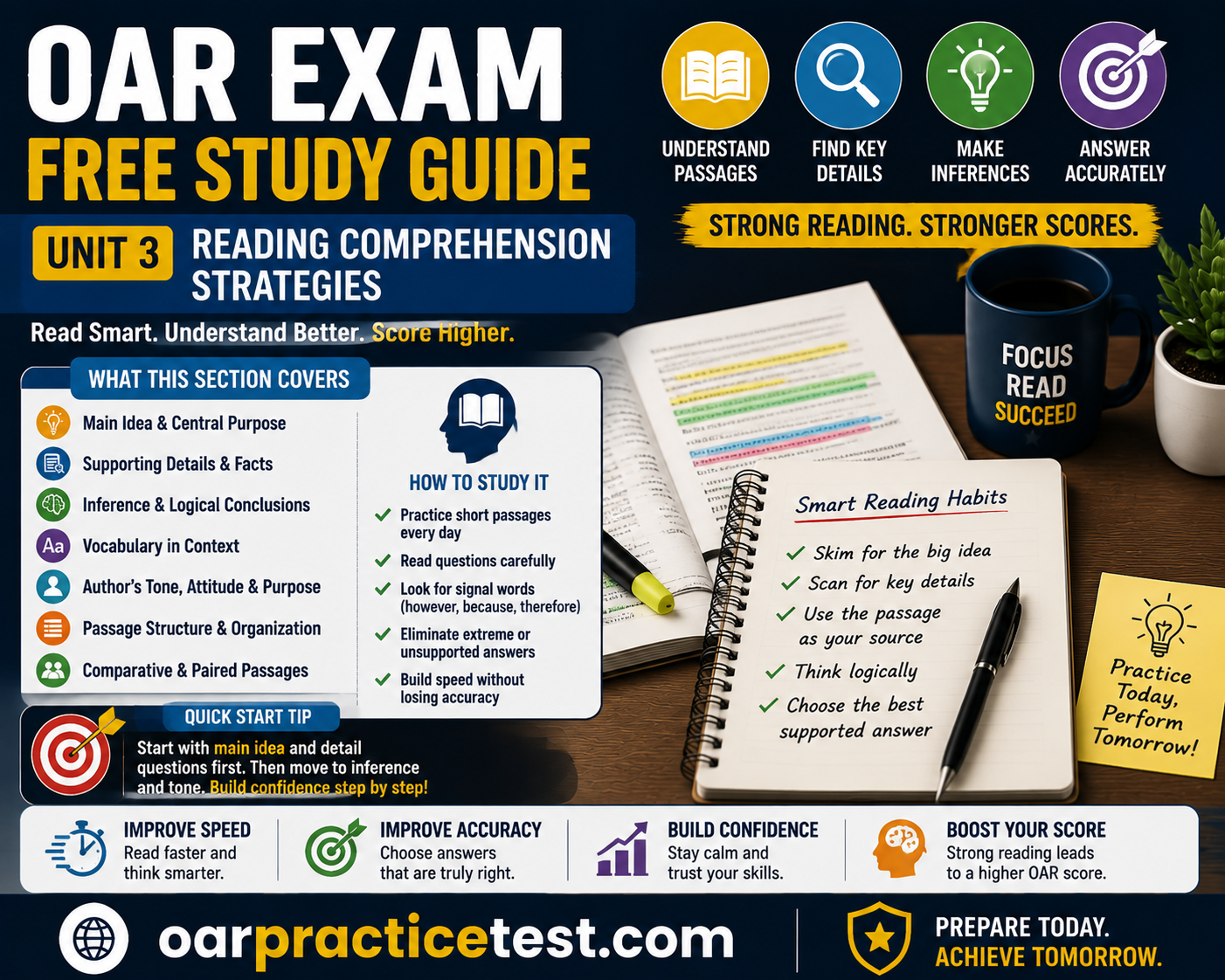
OAR Exam Free Study Guide Unit 3: Reading Comprehension Strategies
The OAR Reading Comprehension section checks how well you can understand short passages, identify the main idea, find supporting details, and make careful inferences from what you read.
It is designed to measure practical reading skill, not just reading speed, so the best results come from reading smartly, staying focused, and using the passage itself as your source of truth.
This section often includes questions about the main idea, supporting details, inference, vocabulary in context, author’s tone, and passage structure.
In some cases, questions may also ask you to compare viewpoints, notice signal words, or understand how one paragraph supports another.
A good way to prepare is to skim the passage first for the overall message, then scan for keywords when answering specific questions.
If a question asks for the author’s tone or purpose, focus on the language used in the passage rather than your own opinion or outside knowledge.
The best reading strategies are simple but powerful: read actively, underline key points in your mind, eliminate choices that are too broad or too extreme, and always choose the answer that is most clearly supported by the text.
With regular practice, you can improve both speed and accuracy, which is exactly what this section rewards.
What This Section Covers
Main idea and central purpose.
Supporting details and factual questions.
Inference and logical conclusion questions.
Vocabulary in context.
Author’s tone, attitude, and purpose.
Passage structure and organization.
Short comparative or paired passage questions.
How to Study It
Practice short passages every day.
Read the question carefully before choosing an answer.
Look for signal words like however, because, and therefore.
Eliminate answers that are too extreme or not supported by the passage.
Time yourself so you build speed without losing accuracy.libguides.
Why It Matters
Strong reading comprehension helps you handle written instructions, reports, and technical material more effectively, which is useful in officer training and real decision-making situations.
On the OAR, good reading performance shows that you can process information quickly and accurately under time pressure.
Quick Start Tip
If you are just beginning, start with main idea and detail questions first, then move to inference and tone, since those usually take more practice to master. That order makes it easier to build confidence without feeling overwhelmed.
Subtopic of OAR Reading Section
3.1. Main Idea and Central Purpose
What it is and why it matters
Main idea questions ask what the passage is mostly about. The central purpose is the author’s main reason for writing the passage. These are some of the most common reading questions on the OAR because they test whether you can understand the big picture, not just small details.
If you can identify the main idea, the rest of the questions become easier. You stop getting distracted by examples and extra information and instead focus on what the author is really trying to say.
How to handle it
Read the first and last sentence carefully because the main idea is often located there.
Ask yourself, “If I had to summarize this passage in one sentence, what would I say?”
Do not choose an answer that is too narrow, too broad, or only about one small detail.
The best answer should cover the whole passage, not just a part of it.
Common question patterns
What is the main idea of the passage?
Which statement best summarizes the passage?
What is the author’s primary purpose?
Practice tip
If a passage talks about the benefits of teamwork, examples of good communication, and a final conclusion about leadership, the main idea is probably about teamwork or effective collaboration, not just one example inside the passage.
3.2. Supporting Details
What it is and why it matters
Supporting detail questions ask about facts, examples, reasons, or information directly mentioned in the passage. These questions test whether you can locate and understand the exact information the author gives.
This is important because many reading mistakes happen when people guess instead of checking the text carefully. The OAR rewards accuracy, so the answer must match the passage.
How to handle it
Scan the passage for the keyword or idea from the question.
Look for the sentence that directly answers the question.
Do not add outside knowledge.
Be careful with answer choices that sound close but change the meaning slightly.
Common question patterns
According to the passage, which of the following is true?
What example does the author use?
Which detail is mentioned in the passage?
Practice tip
If the passage says a new process improved speed but increased cost, do not choose an answer that says it improved speed and reduced cost. Even a small change can make the choice wrong.
3.3 Inference and Logical Conclusion
What it is and why it matters
Inference questions ask you to figure out what the passage suggests, even if it does not say it directly. These questions are a little harder because you must read between the lines without going too far.
On the OAR, inference questions matter because officer-level reading often requires understanding implications, not just stated facts.
How to handle it
Start with what the passage clearly says.
Ask what must be true if those statements are true.
Choose the safest conclusion, not the most dramatic one.
Avoid answers that go beyond the passage or introduce new facts.
Common question patterns
It can be inferred that…
The passage suggests that…
Which conclusion is best supported?
Practice tip
If a passage says a machine worked well in dry conditions but failed in heavy rain, you can infer that moisture may be a problem. You should not infer that the machine is completely useless in all weather.
3.4 Vocabulary in Context
What it is and why it matters
Vocabulary in context questions ask what a word or phrase means based on how it is used in the passage. The test is not asking for memorized dictionary definitions. It is checking whether you can understand meaning from context.
This is useful for OAR because passages may include technical or unfamiliar terms, and you still need to keep reading without getting stuck.
How to handle it
Read the sentence before and after the word.
Look for clues like contrast words, examples, or definitions.
Replace the word with each answer choice and see which one fits best.
Choose the meaning that matches the passage, not just a general meaning.
Common question patterns
In the passage, the word “_” most nearly means…
The phrase “_” suggests that…
What does the word “_” mean as used in the passage?
Practice tip
If the passage says a process was “efficient,” the word probably means it saved time, used resources well, or worked smoothly — not just that it was interesting or popular.
3.5 Author’s Tone and Attitude
What it is and why it matters
Tone means the author’s attitude toward the subject. It can be positive, negative, neutral, serious, critical, hopeful, or persuasive. Tone questions check whether you can sense how the author feels while writing.
This matters on the OAR because tone helps you understand the author’s purpose and the message behind the words.
How to handle it
Look at the kind of words the author uses.
Check whether the passage sounds objective, emotional, warning, supportive, or argumentative.
Do not confuse tone with topic.
The same topic can be written in many different tones.
Common question patterns
What is the tone of the passage?
The author’s attitude toward the subject is…
Which word best describes the author’s viewpoint?
Practice tip
A passage describing a problem in a calm, fact-based way has a neutral or objective tone. A passage telling readers to take action immediately usually has a more urgent or persuasive tone.
3.6 Passage Structure
What it is and why it matters
Passage structure is about how the author organizes ideas. Some passages start with a problem and end with a solution. Others begin with background information and then give examples. Understanding structure helps you move through the passage faster.
This is important because when you know the role of each paragraph, you can answer questions more easily and avoid confusion.
How to handle it
Identify the purpose of each paragraph.
Notice transition words like however, therefore, for example, and in conclusion.
Ask whether a paragraph gives background, support, contrast, or a final summary.
Think about how the author builds the argument from one part to the next.
Common question patterns
What is the role of the second paragraph?
How is the passage organized?
The author develops the passage by…
Practice tip
If the first paragraph introduces a problem and the second paragraph gives a possible solution, the structure is probably problem-and-solution.
3.7 Comparative and Paired Passages
What it is and why it matters
Sometimes reading questions use two short passages instead of one. These passages may agree, disagree, or present different views on the same topic. This tests your ability to compare ideas and see how two writers approach the same subject.
This type of question is useful for the OAR because it checks deeper understanding, not just simple recall.
How to handle it
Read each passage separately and note the main point.
Compare the tone, purpose, and viewpoint of both passages.
Be careful not to mix up which author said what.
For comparison questions, focus on similarities and differences.
Common question patterns
How do the two passages differ?
Which passage supports a particular claim?
What do both authors agree on?
Practice tip
If one passage focuses on cost and the other focuses on safety, you should clearly separate those themes before answering comparison questions.
3.8 Detail vs. Inference Questions
What it is and why it matters
A lot of students mix up detail questions and inference questions. Detail questions ask what the passage says directly. Inference questions ask what the passage implies. Knowing the difference saves time and prevents wrong answers.
This is one of the most important reading skills because many tricky answer choices are built to confuse these two types.
How to handle it
For detail questions, find the exact line or sentence in the passage.
For inference questions, think about what the passage hints at but does not clearly state.
Do not treat an inference as a direct fact.
Do not turn a direct fact into a bigger conclusion than the text supports.
Common question patterns
According to the passage…
It can be inferred that…
Which statement is directly supported?
Practice tip
If the passage says a student studied hard and passed the exam, a detail question may ask whether the student studied hard. An inference question may ask what the passage suggests about effort and success.
3.9 Time Management and Reading Speed
What it is and why it matters
The OAR is timed, so reading speed matters, but rushing is risky. You need to move quickly while still understanding the passage well enough to answer accurately.
A balanced pace is better than trying to read every word slowly. The goal is smart reading, not perfect reading.
How to handle it
Skim for the main idea first.
Read with a purpose.
Spend less time on easy detail questions and more on harder inference or tone questions.
If a question feels too difficult, mark it mentally and move on.
Common question patterns
There is no special question type here — this is more about how you manage all question types.
Time pressure affects every passage and every question.
Practice tip
Practice with a timer so you get used to reading under pressure. Even short daily practice can improve speed and confidence.
3.10 Best Strategy for the Reading Section
A simple step-by-step method
Read the passage once for the general idea.
Notice the tone and structure.
Read the question carefully.
Go back to the passage and find the part that answers it.
Eliminate choices that are too extreme, unsupported, or off-topic.
Choose the answer that fits the text best.
Why this works
This method keeps you focused on the passage and reduces guessing. It also helps you avoid mistakes caused by overthinking or bringing in outside knowledge.
Good habit to build
Train yourself to ask, “Where in the passage is this supported?” That one habit can improve accuracy a lot.
3.11 Quick Study Routine
A simple routine for this section can look like this:
Read one short passage daily.
Answer 3 to 5 questions from that passage.
Mix question types: main idea, detail, inference, tone, and vocabulary.
Review wrong answers and check why they were wrong.
Time yourself once or twice a week.
If you stay consistent, your reading accuracy will improve faster than you expect.
3.12 Short Practice Example
Passage idea:
A company introduced a new safety rule after several small accidents. At first, workers found the rule annoying, but later they realized it reduced mistakes and improved teamwork.
Possible questions:
What is the main idea?
What was the workers’ first reaction?
What can be inferred about the safety rule?
What is the tone of the passage?
This kind of passage is useful because it can test main idea, detail, inference, and tone all at once.
OAR Reading Comprehension Practice Test
OAR Reading Comprehension Practice Test is designed to help you strengthen the core reading skills needed for the OAR exam, including finding main ideas, identifying supporting details, drawing inferences and conclusions, and understanding vocabulary in context. This focused practice test gives you a clear way to assess your preparation, improve speed and accuracy, and build confidence before the exam.
Time limit: 0
Quiz-summary
0 of 20 questions completed
Questions:
1
2
3
4
5
6
7
8
9
10
11
12
13
14
15
16
17
18
19
20
Information
Test Instructions No. of Questions: 20 Questions: Multiple choice with 4 options (A, B, C, D) Review: You can flag questions for review and return to them Submission: Click “Submit Test” when ready to finish.
You have already completed the quiz before. Hence you can not start it again.
Quiz is loading...
You must sign in or sign up to start the quiz.
You have to finish following quiz, to start this quiz:
Results
0 of 20 questions answered correctly
Your time:
Time has elapsed
You have reached 0 of 0 points, (0)
Categories
Not categorized0%
1
2
3
4
5
6
7
8
9
10
11
12
13
14
15
16
17
18
19
20
Answered
Review
Question 1 of 20
1. Question
A passage states: ‘Modern satellite navigation systems offer unprecedented positional accuracy, yet their reliance on fragile orbital infrastructure and susceptibility to signal jamming make them a single point of failure. Experienced navigators argue that proficiency in traditional celestial and chart-based methods remains operationally essential.’ What is the central argument?
Correct
The passage makes two moves: (1) Acknowledges satellite navigation’s STRENGTH (unprecedented accuracy). (2) Identifies its VULNERABILITY (single point of failure through jamming/infrastructure). (3) Concludes that traditional skills therefore REMAIN essential. The word ‘yet’ signals a contrast — the main idea lives in that contrast
Incorrect
The passage makes two moves: (1) Acknowledges satellite navigation’s STRENGTH (unprecedented accuracy). (2) Identifies its VULNERABILITY (single point of failure through jamming/infrastructure). (3) Concludes that traditional skills therefore REMAIN essential. The word ‘yet’ signals a contrast — the main idea lives in that contrast
Question 2 of 20
2. Question
A passage notes: ‘The vessel had completed 14 scheduled maintenance cycles since its last major overhaul. Records show each cycle was marked ‘expedited’ — finished in roughly half the standard time. Six months later, a propulsion failure required an emergency dry-docking.’ What can most reasonably be inferred?
Correct
The propulsion failure follows logically as a potential CONSEQUENCE of cutting maintenance short. The six-month gap and the direct causal link between rushed maintenance and mechanical failure is the inference the evidence supports.
Incorrect
The propulsion failure follows logically as a potential CONSEQUENCE of cutting maintenance short. The six-month gap and the direct causal link between rushed maintenance and mechanical failure is the inference the evidence supports.
Question 3 of 20
3. Question
A passage reads: ‘The admiral’s orders were terse but unambiguous — a stark contrast to the verbose directives that had confused the fleet during the previous campaign.’ What does ‘verbose’ most nearly mean?
Correct
Use CONTRAST as your guide. The sentence contrasts ‘verbose directives’ with ‘terse but unambiguous’ orders. ‘Terse’ means brief. If the admiral’s style is terse and the CONTRAST is verbose, verbose must mean the opposite — using excessive words. WORD ORIGIN: From Latin ‘verbum’ (word) — ‘verbose’ literally means ‘full of words.’
Incorrect
Use CONTRAST as your guide. The sentence contrasts ‘verbose directives’ with ‘terse but unambiguous’ orders. ‘Terse’ means brief. If the admiral’s style is terse and the CONTRAST is verbose, verbose must mean the opposite — using excessive words. WORD ORIGIN: From Latin ‘verbum’ (word) — ‘verbose’ literally means ‘full of words.’
Question 4 of 20
4. Question
A passage systematically compares five types of sonar technology — active, passive, bistatic, synthetic aperture, and multibeam — providing technical specifications, operational ranges, and depth capabilities for each, without recommending any specific type. What is the author’s primary purpose?
Correct
Author’s purpose is identified by WHAT the text does, not what it discusses. Key signals: Technical specifications → informational, not emotional Operational ranges and depth capabilities → factual data, not argument No recommendation made → the author is not advocating a position
Incorrect
Author’s purpose is identified by WHAT the text does, not what it discusses. Key signals: Technical specifications → informational, not emotional Operational ranges and depth capabilities → factual data, not argument No recommendation made → the author is not advocating a position
Question 5 of 20
5. Question
A passage about a training exercise concludes: ‘Despite three equipment failures and a storm that cut visibility to near zero, the crew executed every task with textbook precision. Their composure under conditions that would have broken lesser units was nothing short of remarkable.’ What is the tone?
Correct
Tone is the author’s EMOTIONAL ATTITUDE toward the subject, revealed through word choice and what the author chooses to emphasize.
Incorrect
Tone is the author’s EMOTIONAL ATTITUDE toward the subject, revealed through word choice and what the author chooses to emphasize.
Question 6 of 20
6. Question
A report states: ‘Engine output declined by 22 % over the six-month monitoring period. This catastrophic deterioration demonstrates that the current maintenance schedule is wholly inadequate and must be overhauled immediately.’ Identify the nature of each part.
Correct
The 22 % decline is a measured, recorded figure from a monitoring period — it can be independently checked and verified, making it a fact. However, calling the deterioration catastrophic is a judgment call. Another analyst might call the same drop significant but manageable. Similarly, saying the maintenance schedule is wholly inadequate and must be overhauled immediately is a recommendation based on the author’s interpretation — not an objective measurement.
Incorrect
The 22 % decline is a measured, recorded figure from a monitoring period — it can be independently checked and verified, making it a fact. However, calling the deterioration catastrophic is a judgment call. Another analyst might call the same drop significant but manageable. Similarly, saying the maintenance schedule is wholly inadequate and must be overhauled immediately is a recommendation based on the author’s interpretation — not an objective measurement.
Question 7 of 20
7. Question
A passage argues that multi-crew resource management (MCRM) training reduces critical errors during complex naval operations. Which piece of evidence would most directly support this argument?
Correct
To support this argument, the evidence needs to directly connect MCRM training to fewer critical errors. It measures the actual outcome (decision-making errors), compares trained versus untrained groups, and gives a specific result (35 % reduction).
Incorrect
To support this argument, the evidence needs to directly connect MCRM training to fewer critical errors. It measures the actual outcome (decision-making errors), compares trained versus untrained groups, and gives a specific result (35 % reduction).
Question 8 of 20
8. Question
A passage reports: ‘Officers assigned to units with structured daily feedback sessions scored an average of 18 points higher on leadership assessments after six months than officers in units without such sessions. The effect held across all experience levels and geographic regions.’ What is the most valid conclusion?
Correct
The data shows a consistent 18-point improvement across different experience levels and regions, which is a strong, generalizable finding. Saying feedback sessions are strongly associated with higher scores accurately reflects what the data shows without overstating it.
Incorrect
The data shows a consistent 18-point improvement across different experience levels and regions, which is a strong, generalizable finding. Saying feedback sessions are strongly associated with higher scores accurately reflects what the data shows without overstating it.
Question 9 of 20
9. Question
A passage argues: ‘Technological superiority alone cannot guarantee mission success. History shows that cohesive, well-led teams with modest equipment consistently outperform fractured, poorly-led teams with superior technology. Leadership and unit cohesion remain the decisive variable on the battlefield.’ What is the central argument?
Correct
The passage is structured as a classic argument: it first concedes that technology matters, then shows through historical examples that leadership and cohesion matter more. The final sentence makes the main claim explicit by calling these the decisive variable.
Incorrect
The passage is structured as a classic argument: it first concedes that technology matters, then shows through historical examples that leadership and cohesion matter more. The final sentence makes the main claim explicit by calling these the decisive variable.
Question 10 of 20
10. Question
A passage describes how a naval base reduced its aviation accident rate from 1 in 800 flights to 1 in 2 400 flights over a five-year period. During this same period, the base implemented mandatory crew resource management training, introduced new fatigue-monitoring protocols, and upgraded its air traffic control systems. What can most reasonably be inferred?
Correct
Three changes happened at the same time as a significant improvement in the accident rate. Since all three were introduced together, the most reasonable inference is that they worked together to produce the better outcome — not that any single one deserves all the credit.
Incorrect
Three changes happened at the same time as a significant improvement in the accident rate. Since all three were introduced together, the most reasonable inference is that they worked together to produce the better outcome — not that any single one deserves all the credit.
Question 11 of 20
11. Question
A passage reads: ‘The technology proliferated rapidly across the fleet once its operational advantages became apparent; within three years, every major surface vessel had been equipped.’ What does ‘proliferated’ most nearly mean?
Correct
The context makes this clear without needing to know the word in advance. The sentence says the technology spread until every major surface vessel had it, and it happened within three years. That is a picture of rapid, widespread adoption.
Incorrect
The context makes this clear without needing to know the word in advance. The sentence says the technology spread until every major surface vessel had it, and it happened within three years. That is a picture of rapid, widespread adoption.
Question 12 of 20
12. Question
A passage opens by describing a recent case of catastrophic flooding aboard a vessel, then systematically examines the three contributing factors — design flaw, procedural failure, and training gap — and closes by presenting corrective recommendations for each factor. What organizational pattern does this passage follow?
Correct
The passage moves from an effect (the flooding) to its causes (the three contributing factors) and then to solutions (the corrective recommendations). This is a cause-and-effect structure that leads into a problem-solution conclusion.
Incorrect
The passage moves from an effect (the flooding) to its causes (the three contributing factors) and then to solutions (the corrective recommendations). This is a cause-and-effect structure that leads into a problem-solution conclusion.
Question 13 of 20
13. Question
A report on a navigation error states: ‘At 0217 hours, the watch officer failed to cross-check the radar fix against the chart. The vessel subsequently grounded. Standard procedures, had they been followed, would have prevented the incident.’ What is the tone?
Correct
The report uses precise timestamps, states facts without drama, and draws a straightforward logical conclusion about what went wrong. There are no emotional words, no sympathy, and no celebration — just a clinical account of events and their cause. This is exactly how a formal incident report is written: calmly and objectively.
Incorrect
The report uses precise timestamps, states facts without drama, and draws a straightforward logical conclusion about what went wrong. There are no emotional words, no sympathy, and no celebration — just a clinical account of events and their cause. This is exactly how a formal incident report is written: calmly and objectively.
Question 14 of 20
14. Question
A passage states: ‘The new destroyer class carries 96 vertical launch cells, a 40 % increase over its predecessor. This superior armament makes it the most capable surface combatant ever commissioned by any navy in history.’ What best describes this statement?
Correct
The first sentence contains two numbers — 96 cells and a 40 % increase — both of which are countable, contractual specifications that can be verified. The second sentence is a very different matter. Calling something the most capable surface combatant ever commissioned by any navy in history requires comparing it against every warship ever built, which is an enormous evaluative claim that reasonable experts could debate. Words like superior, most capable, ever, and any navy in history are strong signals that a judgment is being made, not a measurement reported.
Incorrect
The first sentence contains two numbers — 96 cells and a 40 % increase — both of which are countable, contractual specifications that can be verified. The second sentence is a very different matter. Calling something the most capable surface combatant ever commissioned by any navy in history requires comparing it against every warship ever built, which is an enormous evaluative claim that reasonable experts could debate. Words like superior, most capable, ever, and any navy in history are strong signals that a judgment is being made, not a measurement reported.
Question 15 of 20
15. Question
A passage makes the case that officer candidates who complete a structured mentorship programme during initial training are 60 % less likely to resign within their first five years of service, using data from three separate cohort studies and calling on the navy to mandate mentorship for all officer candidates. What is the author’s primary purpose?
Correct
The passage has two clear features that mark it as persuasive: it uses evidence (three cohort studies) to build a case, and it ends with an explicit call to action (calling on the navy to mandate the programme). When an author assembles data and then tells the reader what should be done about it, the purpose is persuasion.
Incorrect
The passage has two clear features that mark it as persuasive: it uses evidence (three cohort studies) to build a case, and it ends with an explicit call to action (calling on the navy to mandate the programme). When an author assembles data and then tells the reader what should be done about it, the purpose is persuasion.
Question 16 of 20
16. Question
A passage reads: ‘The inspector found the safety reports to be ostensibly thorough — complete in appearance, with every checkbox ticked — yet a deeper review revealed fundamental gaps in the actual inspection data.’ What does ‘ostensibly’ most nearly mean?
Correct
The sentence sets up a contrast between how the reports appeared on the surface and what a deeper review revealed. On the surface, every checkbox was ticked and things looked complete. But the word yet signals that the reality underneath was different — there were fundamental gaps. So ostensibly must mean appearing to be something without actually being it.
Incorrect
The sentence sets up a contrast between how the reports appeared on the surface and what a deeper review revealed. On the surface, every checkbox was ticked and things looked complete. But the word yet signals that the reality underneath was different — there were fundamental gaps. So ostensibly must mean appearing to be something without actually being it.
Question 17 of 20
17. Question
A passage states that a submarine completed 12 patrols over four years with zero equipment-related aborts. The passage also notes the vessel’s maintenance officer had a reputation for never signing off on a report until personally verifying each entry. What can most reasonably be inferred?
Correct
The passage puts two facts side by side: an outstanding reliability record and a maintenance officer known for rigorous personal verification. When an author chooses to mention these together, the implication is that the second helps explain the first. The reasonable inference is that the officer’s careful approach contributed to the excellent record.
Incorrect
The passage puts two facts side by side: an outstanding reliability record and a maintenance officer known for rigorous personal verification. When an author chooses to mention these together, the implication is that the second helps explain the first. The reasonable inference is that the officer’s careful approach contributed to the excellent record.
Question 18 of 20
18. Question
A passage argues: ‘Communication breakdowns are rarely isolated technical failures — they are symptoms of deeper organizational deficiencies including unclear command structures, inadequate training, and cultures that discourage speaking up. Fixing the radio is the easy part; fixing the organization is the real challenge.’ What is the central argument?
Correct
The passage’s core message is stated plainly in its final sentence: fixing the equipment is easy, but the real problem is organizational. The author argues that communication failures are symptoms of deeper issues — command structure, training, and culture — not just broken hardware.
Incorrect
The passage’s core message is stated plainly in its final sentence: fixing the equipment is easy, but the real problem is organizational. The author argues that communication failures are symptoms of deeper issues — command structure, training, and culture — not just broken hardware.
Question 19 of 20
19. Question
A passage claims that regular physical training reduces sick-day absenteeism among naval personnel by improving cardiovascular resilience. Which detail would most directly support this argument?
Correct
To support the claim, the evidence must directly connect physical training to reduced sick days. It compares units that had mandatory PT against those that did not, measures the actual outcome (sick days), and gives a specific number (28 % fewer). That is direct, relevant, and specific evidence.
Incorrect
To support the claim, the evidence must directly connect physical training to reduced sick days. It compares units that had mandatory PT against those that did not, measures the actual outcome (sick days), and gives a specific number (28 % fewer). That is direct, relevant, and specific evidence.
Question 20 of 20
20. Question
A passage reports that warships whose crews received enhanced damage-control training in the six months before deployment reported 55 % fewer flooding incidents during deployment compared with similarly sized vessels whose crews did not receive the training, based on data from 40 vessels over three years. What is the most valid conclusion?
Correct
The data shows a 55 % reduction across 40 vessels over three years, which is a substantial and consistent finding. Saying the training is strongly associated with a meaningful reduction accurately represents what the data shows — without going beyond it.
Incorrect
The data shows a 55 % reduction across 40 vessels over three years, which is a substantial and consistent finding. Saying the training is strongly associated with a meaningful reduction accurately represents what the data shows — without going beyond it.