
OAR Exam Free Study Guide Unit 6: OAR Test-Day Tips, Mindset, and Next Steps
This section helps you prepare for the final stage of the OAR, where your knowledge, speed, and confidence all come together.
It focuses on how to manage time, stay calm, handle difficult questions, and make smart decisions during the test.
The OAR is not only about what you know. It is also about how well you perform under pressure.
Even a well-prepared student can lose marks by rushing, panicking, or spending too long on one hard question.
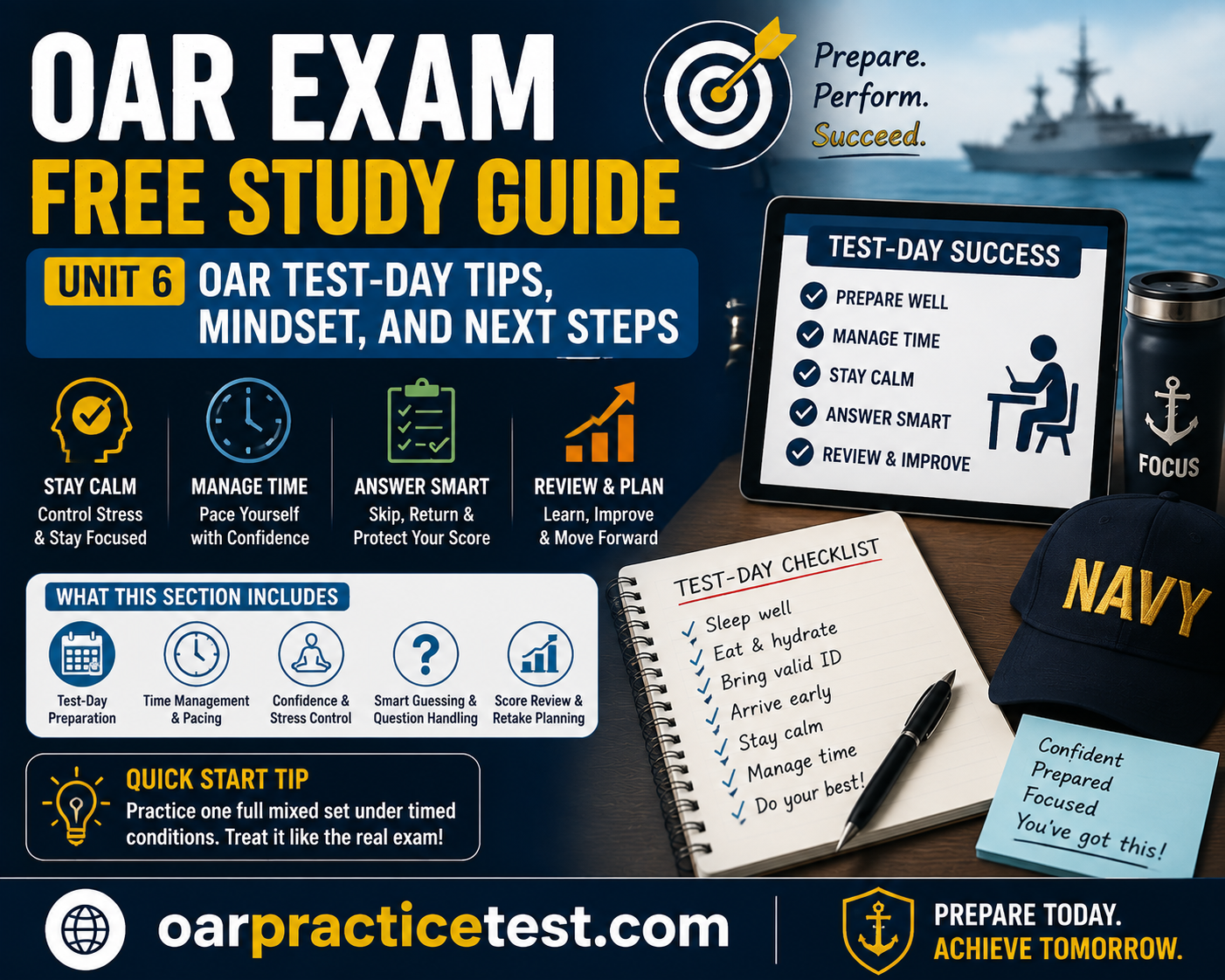
That is why this section is useful. It gives you simple test-day habits that can protect your score and help you stay focused from start to finish.
It also helps you understand what to do after the exam, including how to review your score and plan the next step if needed.
A good test-day strategy includes getting enough rest, arriving early, reading each question carefully, and moving on when a question is taking too much time.
If you can stay calm and steady, you give yourself a much better chance of doing well.
What This Section Includes
- Test-day preparation.
- Time management and pacing.
- Confidence and stress control.
- Smart guessing and question handling.
- Score review and retake planning.
How to Study It
- Practice under timed conditions.
- Learn when to skip and return to a hard question.
- Stay calm and trust your preparation.
- Review your score after practice tests.
- Make a plan for weak areas.
Why It Matters
This section helps you turn preparation into performance. Good habits on test day can make a big difference, especially when the exam feels stressful or time is limited.
Quick Start Tip
Before test day, practice one full mixed set under timed conditions and act like it is the real exam. That will help you build confidence and make your actual test feel more familiar.
Subtopic of OAR Test-Day Tips, Mindset, and Next Steps
1. Test-Day Preparation
Why it matters
The best test-day performance starts before you enter the exam room. Sleep, food, and simple logistics can affect focus and energy more than many people expect.
What to do
- Get enough sleep the night before.
- Eat a balanced breakfast or light meal before the exam.
- Bring the required ID and anything the testing center asks for.
- Arrive early so you are not rushed.
- Leave unnecessary items behind so you can stay focused.
Simple example
If you arrive late and stressed, your mind may still be racing when the test starts. If you arrive early and calm, you begin with a much better focus.
2. Time Management and Pacing
Why it matters
The OAR is timed, so pacing is a major part of success. If you spend too long on one hard question, you may lose points on questions you could have answered later.
What to do
- Keep a loose eye on the clock throughout the test.
- Do not get stuck on one question for too long.
- Move on if a problem is taking too much time.
- Return to harder questions only if time allows.
Simple example
If a mechanical question is taking too long, it is better to make your best choice and move forward than to sacrifice several easier questions that come later.
3. Staying Calm and Focused
Why it matters
Stress can make even simple questions feel harder. A calm mind reads better, thinks more clearly, and avoids careless errors.
What to do
- Take a deep breath before each section.
- Read each question slowly enough to understand it.
- Do not let one hard problem affect the next one.
- Stay positive and trust your preparation.
Simple example
If you miss one math question, do not panic. One mistake does not decide the whole test.
4. Smart Guessing and Question Control
Why it matters
Sometimes you will not know the answer right away. In that case, the goal is to make the smartest possible guess instead of wasting too much time.
What to do
- Eliminate answers that are clearly wrong.
- Compare the remaining choices carefully.
- Choose the answer that best fits the passage, formula, or diagram.
- Do not keep changing answers unless you are sure you made a mistake.
Simple example
If two answer choices are obviously wrong and two are close, focus on the small difference between the last two instead of starting over.
5. Handling Hard Questions
Why it matters
Every test includes difficult questions. A hard question does not mean you are failing; it simply means the test is challenging.
What to do
- Stay calm when a question looks unfamiliar.
- Break the problem into small parts.
- Look for clues in the question itself.
- Skip and return if the question is taking too long.
Simple example
If a reading question has two similar answers, go back to the passage and find the exact line that supports one choice better than the other.
6. After the Test
Why it matters
Your score gives you useful information, even if it is not exactly what you wanted. It tells you what is strong and what still needs work.jobtestprep+1
What to do
- Review your score carefully.
- Compare it with your target program or goal.
- Identify your strongest and weakest sections.
- Decide whether you need more study before retaking.
Simple example
If math was strong but mechanical comprehension was weak, your next study plan should focus more on mechanical topics rather than restarting everything from the beginning.
7. Retake Strategy
Why it matters
If you do not reach your goal score, the next step should be smart improvement, not random repetition.jobtestprep+1
What to do
- Review your weak areas in detail.
- Use practice tests to see whether your score improves.
- Focus on the topics that caused the most trouble.
- Retake only after you have made real progress.
Simple example
A good retake plan might mean spending two weeks on weak mechanical topics, then doing another timed mixed test to check improvement.
8. Best Mindset for Test Day
What works best
The best mindset is simple: stay calm, stay focused, and trust your preparation.etipta+2
Remember this
- One hard question does not define your score.
- Careful pacing matters.
- Confidence helps you think clearly.
- Preparation works best when combined with calm execution.
9. Quick Test-Day Checklist
- Sleep well the night before.
- Eat and hydrate before the exam.
- Bring valid ID.
- Arrive early.
- Stay calm and focused.
- Manage your time wisely.
- Guess smartly when needed.
10. Short Practice Example
Example idea:
You are on the last section of the test and two mechanical questions look difficult. One is taking too long, but you still have several unanswered questions left.
Best action:
Make your best choice, move on, and protect your time for the remaining questions. That is usually the smarter test-day decision.