
Free OAR Practice Test 2 – Officer Aptitude Rating Test Prep 2026
Boost your OAR score with Free OAR Practice Test 2 from our series of Six OAR Practice Test , a focused mock test designed to match the actual OAR style and difficulty.
Take this free OAR practice test with 30 carefully designed questions covering all three OAR sections — Math Skills, Reading Comprehension, and Mechanical Comprehension — so you can check your strengths, find weak spots, and improve your speed before exam day. Each question includes a clear explanation to help you understand the method, not just the answer.
This OAR Practice Test is ideal for learners who want realistic practice, better time management, and a strong review of key OAR concepts. Use it as a full-length practice session or section-by-section revision to build confidence and improve accuracy.
Quiz-summary
0 of 30 questions completed
Questions:
- 1
- 2
- 3
- 4
- 5
- 6
- 7
- 8
- 9
- 10
- 11
- 12
- 13
- 14
- 15
- 16
- 17
- 18
- 19
- 20
- 21
- 22
- 23
- 24
- 25
- 26
- 27
- 28
- 29
- 30
Information
Test Instructions
No. of Questions: 30
Questions: Multiple choice with 4 options (A, B, C, D)
Review: You can flag questions for review and return to them
Submission: Click “Submit Test” when ready to finish
You have already completed the quiz before. Hence you can not start it again.
Quiz is loading...
You must sign in or sign up to start the quiz.
You have to finish following quiz, to start this quiz:
Results
0 of 30 questions answered correctly
Your time:
Time has elapsed
You have reached 0 of 0 points, (0)
| Average score |
|
| Your score |
|
Categories
- Not categorized 0%
- 1
- 2
- 3
- 4
- 5
- 6
- 7
- 8
- 9
- 10
- 11
- 12
- 13
- 14
- 15
- 16
- 17
- 18
- 19
- 20
- 21
- 22
- 23
- 24
- 25
- 26
- 27
- 28
- 29
- 30
- Answered
- Review
-
Question 1 of 30
1. Question
Passage: ‘Electromagnetic induction, discovered by Faraday, demonstrates that a changing magnetic field generates an electric current in a conductor. This principle underlies the operation of generators, transformers, and induction motors. The induced EMF is proportional to the rate of change of magnetic flux through the conductor loop, as expressed by Faraday’s law: ε = −N(dΦ/dt).’
According to Faraday’s law, what determines the magnitude of induced EMF?
Correct
The passage states that ‘induced EMF is proportional to the rate of change of magnetic flux’ and gives the formula ε = −N(dΦ/dt) where (dΦ/dt) represents rate of change of flux.
Incorrect
The passage states that ‘induced EMF is proportional to the rate of change of magnetic flux’ and gives the formula ε = −N(dΦ/dt) where (dΦ/dt) represents rate of change of flux.
-
Question 2 of 30
2. Question
Passage: ‘Electromagnetic induction, discovered by Faraday, demonstrates that a changing magnetic field generates an electric current in a conductor. This principle underlies the operation of generators, transformers, and induction motors. The induced EMF is proportional to the rate of change of magnetic flux through the conductor loop, as expressed by Faraday’s law: ε = −N(dΦ/dt).’
Which devices mentioned in the passage operate on electromagnetic induction?
Correct
The passage explicitly states: ‘This principle underlies the operation of generators, transformers, and induction motors.’
Incorrect
The passage explicitly states: ‘This principle underlies the operation of generators, transformers, and induction motors.’
-
Question 3 of 30
3. Question
Passage: ‘Electromagnetic induction, discovered by Faraday, demonstrates that a changing magnetic field generates an electric current in a conductor. This principle underlies the operation of generators, transformers, and induction motors. The induced EMF is proportional to the rate of change of magnetic flux through the conductor loop, as expressed by Faraday’s law: ε = −N(dΦ/dt).’
The negative sign in Faraday’s law (ε = −N(dΦ/dt)) represents:
Correct
The negative sign in Faraday’s law represents Lenz’s law, which states that the induced current opposes the change that produced it.
Incorrect
The negative sign in Faraday’s law represents Lenz’s law, which states that the induced current opposes the change that produced it.
-
Question 4 of 30
4. Question
Passage: ‘Supersonic flight involves aircraft traveling faster than the speed of sound (Mach 1). At these speeds, compression waves cannot outrun the aircraft, resulting in shock wave formation. The shock waves create sonic booms and significantly increase drag, requiring specialized engine designs such as afterburning turbojets or ramjets to maintain thrust at high Mach numbers.’
What causes increased drag in supersonic flight?
Correct
The passage states that ‘shock waves…significantly increase drag’ during supersonic flight.
Incorrect
The passage states that ‘shock waves…significantly increase drag’ during supersonic flight.
-
Question 5 of 30
5. Question
Passage: ‘Supersonic flight involves aircraft traveling faster than the speed of sound (Mach 1). At these speeds, compression waves cannot outrun the aircraft, resulting in shock wave formation. The shock waves create sonic booms and significantly increase drag, requiring specialized engine designs such as afterburning turbojets or ramjets to maintain thrust at high Mach numbers.’
According to the passage, what engine types are needed for supersonic flight?
Correct
The passage mentions ‘specialized engine designs such as afterburning turbojets or ramjets’ are required for high Mach numbers.
Incorrect
The passage mentions ‘specialized engine designs such as afterburning turbojets or ramjets’ are required for high Mach numbers.
-
Question 6 of 30
6. Question
Passage: ‘Supersonic flight involves aircraft traveling faster than the speed of sound (Mach 1). At these speeds, compression waves cannot outrun the aircraft, resulting in shock wave formation. The shock waves create sonic booms and significantly increase drag, requiring specialized engine designs such as afterburning turbojets or ramjets to maintain thrust at high Mach numbers.’
The term ‘Mach 1’ refers to:
Correct
The passage defines supersonic flight as ‘faster than the speed of sound (Mach 1),’ indicating Mach 1 equals the speed of sound.
Incorrect
The passage defines supersonic flight as ‘faster than the speed of sound (Mach 1),’ indicating Mach 1 equals the speed of sound.
-
Question 7 of 30
7. Question
Passage: ‘Submarine hull design must withstand enormous hydrostatic pressure that increases by approximately 1 atmosphere (14.7 PSI) for every 33 feet of depth. Modern nuclear submarines can operate at depths exceeding 800 feet, where pressures reach 25 atmospheres. Hull construction typically employs high-strength steel with careful attention to welding quality and pressure hull geometry to prevent catastrophic implosion.’
At 800 feet depth, what is the approximate pressure?
Correct
The passage directly states: ‘Modern nuclear submarines can operate at depths exceeding 800 feet, where pressures reach 25 atmospheres.’
Incorrect
The passage directly states: ‘Modern nuclear submarines can operate at depths exceeding 800 feet, where pressures reach 25 atmospheres.’
-
Question 8 of 30
8. Question
Passage: ‘Submarine hull design must withstand enormous hydrostatic pressure that increases by approximately 1 atmosphere (14.7 PSI) for every 33 feet of depth. Modern nuclear submarines can operate at depths exceeding 800 feet, where pressures reach 25 atmospheres. Hull construction typically employs high-strength steel with careful attention to welding quality and pressure hull geometry to prevent catastrophic implosion.’
How much does pressure increase per 33 feet of depth?
Correct
The passage states pressure ‘increases by approximately 1 atmosphere (14.7 PSI) for every 33 feet of depth,’ showing both values are equivalent.
Incorrect
The passage states pressure ‘increases by approximately 1 atmosphere (14.7 PSI) for every 33 feet of depth,’ showing both values are equivalent.
-
Question 9 of 30
9. Question
Passage: ‘Submarine hull design must withstand enormous hydrostatic pressure that increases by approximately 1 atmosphere (14.7 PSI) for every 33 feet of depth. Modern nuclear submarines can operate at depths exceeding 800 feet, where pressures reach 25 atmospheres. Hull construction typically employs high-strength steel with careful attention to welding quality and pressure hull geometry to prevent catastrophic implosion.’
What is the primary concern in submarine hull construction?
Correct
The passage mentions hull construction focuses on ‘preventing catastrophic implosion’ due to enormous pressure.
Incorrect
The passage mentions hull construction focuses on ‘preventing catastrophic implosion’ due to enormous pressure.
-
Question 10 of 30
10. Question
Passage: ‘Submarine hull design must withstand enormous hydrostatic pressure that increases by approximately 1 atmosphere (14.7 PSI) for every 33 feet of depth. Modern nuclear submarines can operate at depths exceeding 800 feet, where pressures reach 25 atmospheres. Hull construction typically employs high-strength steel with careful attention to welding quality and pressure hull geometry to prevent catastrophic implosion.’
The passage suggests that welding quality is important because:
Correct
The passage emphasizes ‘careful attention to welding quality’ in the context of withstanding enormous pressure and preventing implosion.
Incorrect
The passage emphasizes ‘careful attention to welding quality’ in the context of withstanding enormous pressure and preventing implosion.
-
Question 11 of 30
11. Question
Passage: ‘Submarine hull design must withstand enormous hydrostatic pressure that increases by approximately 1 atmosphere (14.7 PSI) for every 33 feet of depth. Modern nuclear submarines can operate at depths exceeding 800 feet, where pressures reach 25 atmospheres. Hull construction typically employs high-strength steel with careful attention to welding quality and pressure hull geometry to prevent catastrophic implosion.’
Based on the passage, pressure hull geometry refers to:
Correct
In context of withstanding ‘enormous hydrostatic pressure’ and preventing ‘catastrophic implosion,’ pressure hull geometry refers to structural design.
Incorrect
In context of withstanding ‘enormous hydrostatic pressure’ and preventing ‘catastrophic implosion,’ pressure hull geometry refers to structural design.
-
Question 12 of 30
12. Question
Passage: ‘Submarine hull design must withstand enormous hydrostatic pressure that increases by approximately 1 atmosphere (14.7 PSI) for every 33 feet of depth. Modern nuclear submarines can operate at depths exceeding 800 feet, where pressures reach 25 atmospheres. Hull construction typically employs high-strength steel with careful attention to welding quality and pressure hull geometry to prevent catastrophic implosion.’
The author’s tone regarding submarine engineering is:
Correct
The passage presents technical information about submarine design without emotional language, maintaining an informative, factual tone.
Incorrect
The passage presents technical information about submarine design without emotional language, maintaining an informative, factual tone.
-
Question 13 of 30
13. Question
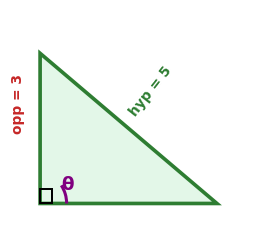
If sin(θ) = 3/5 and θ is in the first quadrant, what is cos(θ)?
 Correct
Using Pythagorean identity: sin²θ + cos²θ = 1. So (3/5)² + cos²θ = 1. cos²θ = 1 – 9/25 = 16/25. Therefore cos(θ) = 4/5 (positive in first quadrant).
Incorrect
Using Pythagorean identity: sin²θ + cos²θ = 1. So (3/5)² + cos²θ = 1. cos²θ = 1 – 9/25 = 16/25. Therefore cos(θ) = 4/5 (positive in first quadrant).
-
Question 14 of 30
14. Question
A geometric series has first term a = 2 and common ratio r = 3. What is the sum of the first 5 terms?
Correct
Using the geometric-series formula Sn=a(r^n – 1)/(r – 1) = 2(3^5 – 1)/(3 – 1) = 2(243 – 1)/2 = 242. (where ^ means Power)
Incorrect
Using the geometric-series formula Sn=a(r^n – 1)/(r – 1) = 2(3^5 – 1)/(3 – 1) = 2(243 – 1)/2 = 242. (where ^ means Power)
-
Question 15 of 30
15. Question
If f(x)=3x^2−4x+1, what is f′(x)?
Correct
Taking the derivative: f'(x) = d/dx(3x² – 4x + 1) = 6x – 4.
Incorrect
Taking the derivative: f'(x) = d/dx(3x² – 4x + 1) = 6x – 4.
-
Question 16 of 30
16. Question
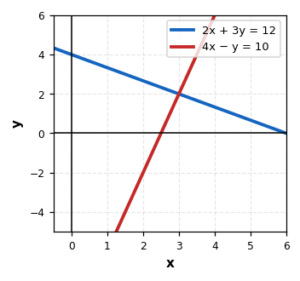
What is the solution to the system: 2x + 3y = 12, 4x – y = 10 ?
 Correct
From equation 2: y = 4x – 10. Substituting the value of y in equation 1: 2x + 3(4x – 10) = 12. 2x + 12x – 30 = 12. 14x = 42, x = 3. Then y = 4(3) – 10 = 2.
Incorrect
From equation 2: y = 4x – 10. Substituting the value of y in equation 1: 2x + 3(4x – 10) = 12. 2x + 12x – 30 = 12. 14x = 42, x = 3. Then y = 4(3) – 10 = 2.
-
Question 17 of 30
17. Question
A binomial expansion of (2x + 3)⁴ contains how many terms?
Correct
The rule “number of terms = exponent + 1” is a standard property of the binomial theorem for positive integer powers. So,(2x + 3)⁴ contains 4 + 1 = 5 terms.
Incorrect
The rule “number of terms = exponent + 1” is a standard property of the binomial theorem for positive integer powers. So,(2x + 3)⁴ contains 4 + 1 = 5 terms.
-
Question 18 of 30
18. Question
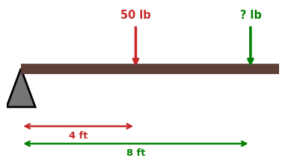
Refer to the figure. What effort force is needed to lift the load?
 Correct
For second-class lever: Effort x Effort arm = Load x Load arm. So, Effort x 8 = 50 x 4. Effort = 200/8 = 25 lb.
Incorrect
For second-class lever: Effort x Effort arm = Load x Load arm. So, Effort x 8 = 50 x 4. Effort = 200/8 = 25 lb.
-
Question 19 of 30
19. Question
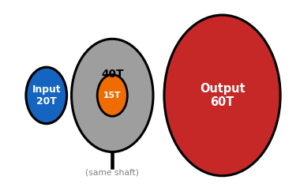
Refer to the figure. What is the overall gear ratio of this compound gear train?
 Correct
First stage ratio: 40/20 = 2:1. Second stage ratio: 60/15 = 4:1. Overall ratio = 2 x 4 = 8:1.
Incorrect
First stage ratio: 40/20 = 2:1. Second stage ratio: 60/15 = 4:1. Overall ratio = 2 x 4 = 8:1.
-
Question 20 of 30
20. Question
Refer to the figure. What upward force must be applied to the handles?
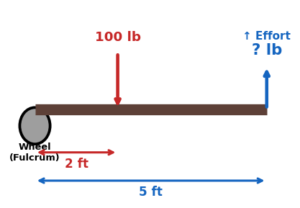 Correct
This is a second-class lever. Force x 5 ft = 100 lb x 2 ft. Force = 200/5 = 40 lb.
Incorrect
This is a second-class lever. Force x 5 ft = 100 lb x 2 ft. Force = 200/5 = 40 lb.
-
Question 21 of 30
21. Question
Refer to the figure. Ignoring friction, what is the approximate splitting force generated perpendicular to each face of the wedge?
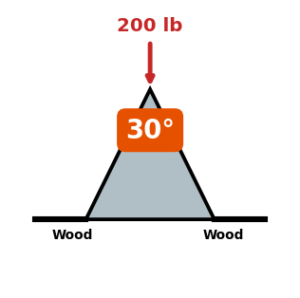 Correct
For a 30° wedge, the force perpendicular to each face = Applied force / sin(30°) = 200 / 0.577 ≈ 346 lb. But the the approximate splitting force perpendicular to wood = 200 × cos(30°) = 200 × 0.866 ≈ 173 lb
Incorrect
For a 30° wedge, the force perpendicular to each face = Applied force / sin(30°) = 200 / 0.577 ≈ 346 lb. But the the approximate splitting force perpendicular to wood = 200 × cos(30°) = 200 × 0.866 ≈ 173 lb
-
Question 22 of 30
22. Question
Refer to the figure. What is the theoretical effort required to lift the load?
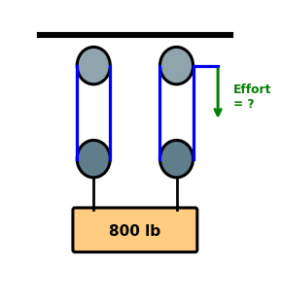 Correct
With 4 supporting rope segments, mechanical advantage = 4. Effort = Load/MA = 800/4 = 200 lb.
Incorrect
With 4 supporting rope segments, mechanical advantage = 4. Effort = Load/MA = 800/4 = 200 lb.
-
Question 23 of 30
23. Question
Find the domain of f(x) = √(x² – 9)
Correct
For √(x² – 9) to be defined, x² – 9 ≥ 0. So x² ≥ 9, Take square roots: |x| ≥ 3 ,which means two solutions: x ≤ -3 OR x ≥ 3.
Incorrect
For √(x² – 9) to be defined, x² – 9 ≥ 0. So x² ≥ 9, Take square roots: |x| ≥ 3 ,which means two solutions: x ≤ -3 OR x ≥ 3.
-
Question 24 of 30
24. Question
A rectangular prism has dimensions 6 cm x 8 cm x 10 cm. What is its surface area?
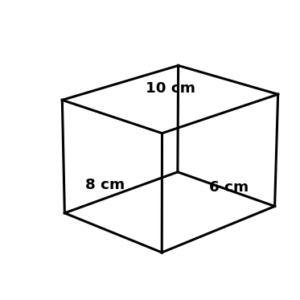 Correct
Surface area = 2(lw + lh + wh) = 2(6×8 + 6×10 + 8×10) = 2(48 + 60 + 80) = 2(188) = 376 cm².
Incorrect
Surface area = 2(lw + lh + wh) = 2(6×8 + 6×10 + 8×10) = 2(48 + 60 + 80) = 2(188) = 376 cm².
-
Question 25 of 30
25. Question
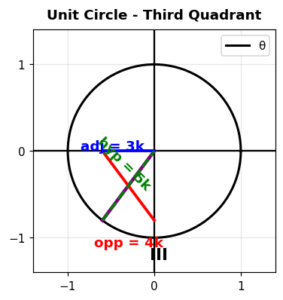
If tan(θ)= 4/3 and θ is in the third quadrant, what is sin(θ)?
 Correct
In quadrant III, both sin and cos are negative. If tan θ = 4/3, then opposite = 4k, adjacent = 3k. Hypotenuse = 5k. So sin(θ) = -4k/5k = -4/5.
Incorrect
In quadrant III, both sin and cos are negative. If tan θ = 4/3, then opposite = 4k, adjacent = 3k. Hypotenuse = 5k. So sin(θ) = -4k/5k = -4/5.
-
Question 26 of 30
26. Question
What is the sum of the infinite geometric series: 12 + 6 + 3 + 1.5 + …?
Correct
This is a geometric series with a = 12, r = 1/2. Sum = a/(1-r) = 12/(1-1/2) = 12/(1/2) = 24.
Incorrect
This is a geometric series with a = 12, r = 1/2. Sum = a/(1-r) = 12/(1-1/2) = 12/(1/2) = 24.
-
Question 27 of 30
27. Question
If log₃(x + 5) = 2, what is the value of x?
Correct
log₃(x + 5) = 2 means 3² = x + 5. So 9 = x + 5, therefore x = 4.
Incorrect
log₃(x + 5) = 2 means 3² = x + 5. So 9 = x + 5, therefore x = 4.
-
Question 28 of 30
28. Question
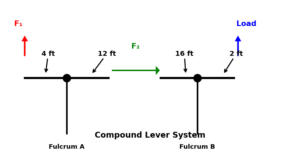
Refer to the figure. What is the mechanical advantage of this compound lever system?
 Correct
The first lever has a mechanical advantage of 12 ÷ 4 = 3. The second lever has a mechanical advantage of 16 ÷ 2 = 8. Because this is a compound lever system, multiply the two lever advantages: 3 × 8 = 24. Therefore, the overall mechanical advantage is 24:1.
Incorrect
The first lever has a mechanical advantage of 12 ÷ 4 = 3. The second lever has a mechanical advantage of 16 ÷ 2 = 8. Because this is a compound lever system, multiply the two lever advantages: 3 × 8 = 24. Therefore, the overall mechanical advantage is 24:1.
-
Question 29 of 30
29. Question
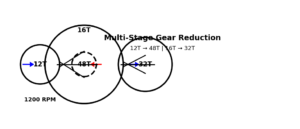
Refer to the figure. If the input shaft rotates at 1200 RPM, what is the output speed?
 Correct
Gear train ratio calculation: (12/48) x (16/32) = (1/4) x (1/2) = 1/8. Output speed = 1200 /8 = 150 RPM. (The first gear pair reduces speed by a factor of 48 ÷ 12 = 4, so the intermediate shaft rotates at 1200 ÷ 4 = 300 RPM. The second gear pair reduces speed by a factor of 32 ÷ 16 = 2, so the output shaft rotates at 300 ÷ 2 = 150 RPM).
Incorrect
Gear train ratio calculation: (12/48) x (16/32) = (1/4) x (1/2) = 1/8. Output speed = 1200 /8 = 150 RPM. (The first gear pair reduces speed by a factor of 48 ÷ 12 = 4, so the intermediate shaft rotates at 1200 ÷ 4 = 300 RPM. The second gear pair reduces speed by a factor of 32 ÷ 16 = 2, so the output shaft rotates at 300 ÷ 2 = 150 RPM).
-
Question 30 of 30
30. Question
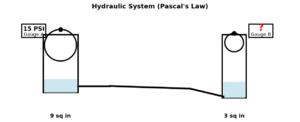
Refer to the figure. What pressure reading will gauge B show?
 Correct
According to Pascal’s law, pressure applied to a confined fluid is transmitted equally throughout the fluid. Since gauge A reads 15 PSI, gauge B will also read 15 PSI, regardless of the piston areas shown.
Incorrect
According to Pascal’s law, pressure applied to a confined fluid is transmitted equally throughout the fluid. Since gauge A reads 15 PSI, gauge B will also read 15 PSI, regardless of the piston areas shown.
Next Practice Test
OAR Practice Test 3 > >