
Free OAR Practice Test 1 – Officer Aptitude Rating Test Prep 2026
Boost your OAR score with Free OAR Practice Test 1 from our series of Six OAR Practice Test , a focused mock test designed to match the actual OAR style and difficulty.
Take this free OAR practice test with 30 carefully designed questions covering all three OAR sections — Math Skills, Reading Comprehension, and Mechanical Comprehension — so you can check your strengths, find weak spots, and improve your speed before exam day. Each question includes a clear explanation to help you understand the method, not just the answer.
This OAR Practice Test is ideal for learners who want realistic practice, better time management, and a strong review of key OAR concepts. Use it as a full-length practice session or section-by-section revision to build confidence and improve accuracy.
Quiz-summary
0 of 30 questions completed
Questions:
- 1
- 2
- 3
- 4
- 5
- 6
- 7
- 8
- 9
- 10
- 11
- 12
- 13
- 14
- 15
- 16
- 17
- 18
- 19
- 20
- 21
- 22
- 23
- 24
- 25
- 26
- 27
- 28
- 29
- 30
Information
Test Instructions
No. of Questions: 30
Questions: Multiple choice with 4 options (A, B, C, D)
Review: You can flag questions for review and return to them
Submission: Click “Submit Test” when ready to finish
You have already completed the quiz before. Hence you can not start it again.
Quiz is loading...
You must sign in or sign up to start the quiz.
You have to finish following quiz, to start this quiz:
Results
0 of 30 questions answered correctly
Your time:
Time has elapsed
You have reached 0 of 0 points, (0)
Categories
- Not categorized 0%
- 1
- 2
- 3
- 4
- 5
- 6
- 7
- 8
- 9
- 10
- 11
- 12
- 13
- 14
- 15
- 16
- 17
- 18
- 19
- 20
- 21
- 22
- 23
- 24
- 25
- 26
- 27
- 28
- 29
- 30
- Answered
- Review
-
Question 1 of 30
1. Question
If 3x² – 2x – 5 = 0, what are the possible values of x?
Correct
Using the quadratic formula: x = (2 ± √(4 + 60))/6 = (2 ± 8)/6. So x = 10/6 = 5/3 or x = -6/6 = -1.
Incorrect
Using the quadratic formula: x = (2 ± √(4 + 60))/6 = (2 ± 8)/6. So x = 10/6 = 5/3 or x = -6/6 = -1.
-
Question 2 of 30
2. Question
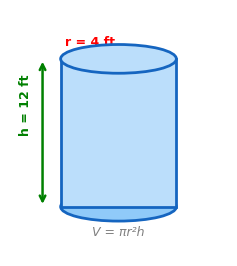
A cylindrical tank has a radius of 4 feet and height of 12 feet. What is its volume in cubic feet? (Use π = 3.14)
 Correct
Volume = πr²h = 3.14 × 4² × 12 = 3.14 × 16 × 12 = 602.88 cubic feet.
Incorrect
Volume = πr²h = 3.14 × 4² × 12 = 3.14 × 16 × 12 = 602.88 cubic feet.
-
Question 3 of 30
3. Question
If log₂(x) = 5, what is the value of x?
Correct
log₂(x) = 5 means 2⁵ = x. Therefore x = 32.
Incorrect
log₂(x) = 5 means 2⁵ = x. Therefore x = 32.
-
Question 4 of 30
4. Question
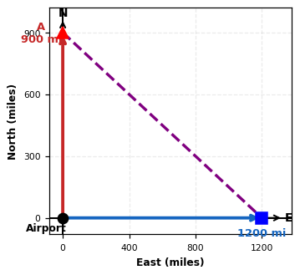
Two planes leave an airport simultaneously. Plane A flies north at 450 mph, Plane B flies east at 600 mph. After 2 hours, what is the straight-line distance between them?
 Correct
After 2 hours: A travels 900 miles north, B travels 1200 miles east. Distance = √(900² + 1200²) = √(810,000 + 1,440,000) = √2,250,000 = 1500 miles.
Incorrect
After 2 hours: A travels 900 miles north, B travels 1200 miles east. Distance = √(900² + 1200²) = √(810,000 + 1,440,000) = √2,250,000 = 1500 miles.
-
Question 5 of 30
5. Question
What is the sum of the arithmetic series: 3 + 7 + 11 + 15 + … + 47?
Correct
This is an arithmetic series with a₁ = 3, d = 4, aₙ = 47. Find n: 47 = 3 + (n-1)4, so n = 12. Sum = n(a₁ + aₙ)/2 = 12(3 + 47)/2 = 300.
Incorrect
This is an arithmetic series with a₁ = 3, d = 4, aₙ = 47. Find n: 47 = 3 + (n-1)4, so n = 12. Sum = n(a₁ + aₙ)/2 = 12(3 + 47)/2 = 300.
-
Question 6 of 30
6. Question
If matrix A = [2 -1; 3 4] and matrix B = [1 2; -2 3], what is A × B?
Correct
Matrix multiplication: (2×1 + (-1)×(-2), 2×2 + (-1)×3) = (4, 1); (3×1 + 4×(-2), 3×2 + 4×3) = (-5, 18). Result: [4 1; -5 18].
Incorrect
Matrix multiplication: (2×1 + (-1)×(-2), 2×2 + (-1)×3) = (4, 1); (3×1 + 4×(-2), 3×2 + 4×3) = (-5, 18). Result: [4 1; -5 18].
-
Question 7 of 30
7. Question
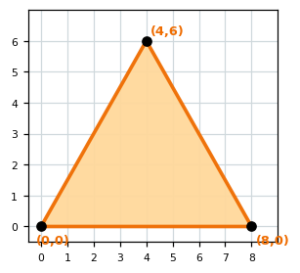
See the figure. What is the area of the shaded triangle?
 Correct
Area of triangle = (1/2) x base x height = (1/2) x 8 x 6 = 24 square units.
Incorrect
Area of triangle = (1/2) x base x height = (1/2) x 8 x 6 = 24 square units.
-
Question 8 of 30
8. Question
If 2^(x+1) = 32, what is the value of x? (where ^ means Power)
Correct
2^(x+1) = 32 = 2^5. Therefore x+1 = 5, so x = 4.
Incorrect
2^(x+1) = 32 = 2^5. Therefore x+1 = 5, so x = 4.
-
Question 9 of 30
9. Question
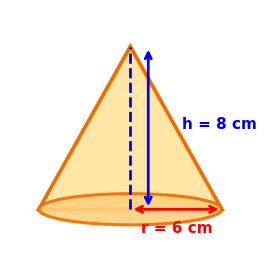
A cone has a base radius of 6 cm and height of 8 cm. What is its volume?
 Correct
Using the cone formula, V = 1/3 πr^2 h, we get V= 1/3 π(6^2)(8) = 1/3 π(36)(8) = 96π cm³.
Incorrect
Using the cone formula, V = 1/3 πr^2 h, we get V= 1/3 π(6^2)(8) = 1/3 π(36)(8) = 96π cm³.
-
Question 10 of 30
10. Question
Passage: ‘Quantum computing harnesses quantum mechanical phenomena such as superposition and entanglement to process information. Unlike classical bits that exist in definitive states of 0 or 1, quantum bits (qubits) can exist in multiple states simultaneously, enabling parallel processing capabilities that could revolutionize cryptography, drug discovery, and artificial intelligence.’
What is the primary distinction between classical and quantum computing?
Correct
The passage explicitly states that unlike classical bits (0 or 1), qubits ‘can exist in multiple states simultaneously.’
Incorrect
The passage explicitly states that unlike classical bits (0 or 1), qubits ‘can exist in multiple states simultaneously.’
-
Question 11 of 30
11. Question
Passage: ‘Quantum computing harnesses quantum mechanical phenomena such as superposition and entanglement to process information. Unlike classical bits that exist in definitive states of 0 or 1, quantum bits (qubits) can exist in multiple states simultaneously, enabling parallel processing capabilities that could revolutionize cryptography, drug discovery, and artificial intelligence.’
According to the passage, quantum computing could impact which fields?
Correct
The passage specifically mentions ‘cryptography, drug discovery, and artificial intelligence’ as fields that could be revolutionized.
Incorrect
The passage specifically mentions ‘cryptography, drug discovery, and artificial intelligence’ as fields that could be revolutionized.
-
Question 12 of 30
12. Question
Passage: ‘Quantum computing harnesses quantum mechanical phenomena such as superposition and entanglement to process information. Unlike classical bits that exist in definitive states of 0 or 1, quantum bits (qubits) can exist in multiple states simultaneously, enabling parallel processing capabilities that could revolutionize cryptography, drug discovery, and artificial intelligence.’
The author’s attitude toward quantum computing is:
Correct
The use of words like ‘harnesses,’ ‘revolutionize,’ and discussing capabilities suggests an optimistic view of quantum computing’s potential.
Incorrect
The use of words like ‘harnesses,’ ‘revolutionize,’ and discussing capabilities suggests an optimistic view of quantum computing’s potential.
-
Question 13 of 30
13. Question
Passage: ‘Aerodynamic efficiency in modern aircraft design involves complex trade-offs between lift generation, drag reduction, and structural integrity. Engineers utilize computational fluid dynamics (CFD) to model airflow patterns around wing surfaces, optimizing shapes that maximize lift-to-drag ratios while maintaining sufficient structural strength to withstand operational stresses.’
What is the primary challenge in aircraft design according to the passage?
Correct
The passage describes ‘complex trade-offs between lift generation, drag reduction, and structural integrity,’ indicating multiple competing requirements.
Incorrect
The passage describes ‘complex trade-offs between lift generation, drag reduction, and structural integrity,’ indicating multiple competing requirements.
-
Question 14 of 30
14. Question
Passage: ‘Aerodynamic efficiency in modern aircraft design involves complex trade-offs between lift generation, drag reduction, and structural integrity. Engineers utilize computational fluid dynamics (CFD) to model airflow patterns around wing surfaces, optimizing shapes that maximize lift-to-drag ratios while maintaining sufficient structural strength to withstand operational stresses.’
What tool do engineers use to optimize aircraft design?
Correct
The passage explicitly states engineers ‘utilize computational fluid dynamics (CFD) to model airflow patterns.’
Incorrect
The passage explicitly states engineers ‘utilize computational fluid dynamics (CFD) to model airflow patterns.’
-
Question 15 of 30
15. Question
Passage: ‘Aerodynamic efficiency in modern aircraft design involves complex trade-offs between lift generation, drag reduction, and structural integrity. Engineers utilize computational fluid dynamics (CFD) to model airflow patterns around wing surfaces, optimizing shapes that maximize lift-to-drag ratios while maintaining sufficient structural strength to withstand operational stresses.’
The passage suggests that optimal wing design must:
Correct
The passage mentions optimizing shapes that maximize lift-to-drag ratios ‘while maintaining sufficient structural strength,’ showing both performance and durability matter.
Incorrect
The passage mentions optimizing shapes that maximize lift-to-drag ratios ‘while maintaining sufficient structural strength,’ showing both performance and durability matter.
-
Question 16 of 30
16. Question
Passage: ‘Naval architecture principles govern the design of vessels capable of operating efficiently in maritime environments. Displacement hulls generate buoyancy through Archimedes’ principle, while planing hulls achieve lift through hydrodynamic forces at higher speeds. The center of gravity and metacentric height are critical factors determining vessel stability in various sea conditions.’
Which principle explains how displacement hulls float?
Correct
The passage directly states that ‘Displacement hulls generate buoyancy through Archimedes’ principle.’
Incorrect
The passage directly states that ‘Displacement hulls generate buoyancy through Archimedes’ principle.’
-
Question 17 of 30
17. Question
Passage: ‘Naval architecture principles govern the design of vessels capable of operating efficiently in maritime environments. Displacement hulls generate buoyancy through Archimedes’ principle, while planing hulls achieve lift through hydrodynamic forces at higher speeds. The center of gravity and metacentric height are critical factors determining vessel stability in various sea conditions.’
What distinguishes planing hulls from displacement hulls?
Correct
The passage contrasts displacement hulls (buoyancy through Archimedes’ principle) with planing hulls that ‘achieve lift through hydrodynamic forces at higher speeds.’
Incorrect
The passage contrasts displacement hulls (buoyancy through Archimedes’ principle) with planing hulls that ‘achieve lift through hydrodynamic forces at higher speeds.’
-
Question 18 of 30
18. Question
Passage: ‘Naval architecture principles govern the design of vessels capable of operating efficiently in maritime environments. Displacement hulls generate buoyancy through Archimedes’ principle, while planing hulls achieve lift through hydrodynamic forces at higher speeds. The center of gravity and metacentric height are critical factors determining vessel stability in various sea conditions.’
According to the passage, vessel stability depends on:
Correct
The passage states ‘The center of gravity and metacentric height are critical factors determining vessel stability.’
Incorrect
The passage states ‘The center of gravity and metacentric height are critical factors determining vessel stability.’
-
Question 19 of 30
19. Question
Passage: ‘Naval architecture principles govern the design of vessels capable of operating efficiently in maritime environments. Displacement hulls generate buoyancy through Archimedes’ principle, while planing hulls achieve lift through hydrodynamic forces at higher speeds. The center of gravity and metacentric height are critical factors determining vessel stability in various sea conditions.’
The term ‘maritime environments’ in the passage refers to:
Correct
Maritime specifically refers to ocean and sea environments, as confirmed by the context of ‘sea conditions.’
Incorrect
Maritime specifically refers to ocean and sea environments, as confirmed by the context of ‘sea conditions.’
-
Question 20 of 30
20. Question
Passage: ‘Naval architecture principles govern the design of vessels capable of operating efficiently in maritime environments. Displacement hulls generate buoyancy through Archimedes’ principle, while planing hulls achieve lift through hydrodynamic forces at higher speeds. The center of gravity and metacentric height are critical factors determining vessel stability in various sea conditions.’
Which type of hull would likely be more efficient at high speeds?
Correct
The passage indicates planing hulls ‘achieve lift through hydrodynamic forces at higher speeds,’ suggesting better high-speed performance.
Incorrect
The passage indicates planing hulls ‘achieve lift through hydrodynamic forces at higher speeds,’ suggesting better high-speed performance.
-
Question 21 of 30
21. Question
Passage: ‘Naval architecture principles govern the design of vessels capable of operating efficiently in maritime environments. Displacement hulls generate buoyancy through Archimedes’ principle, while planing hulls achieve lift through hydrodynamic forces at higher speeds. The center of gravity and metacentric height are critical factors determining vessel stability in various sea conditions.’
The passage is primarily:
Correct
The passage provides factual information about naval architecture principles in an educational manner without selling or recounting history.
Incorrect
The passage provides factual information about naval architecture principles in an educational manner without selling or recounting history.
-
Question 22 of 30
22. Question
Refer to the figure. What weight is needed on the right side to balance this lever?
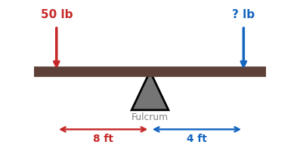 Correct
Using the principle of moments: Force1 × Distance1 = Force2 × Distance2. So 50 lb × 8 ft = Weight × 4 ft. Weight = 400/4 = 100 lb.
Incorrect
Using the principle of moments: Force1 × Distance1 = Force2 × Distance2. So 50 lb × 8 ft = Weight × 4 ft. Weight = 400/4 = 100 lb.
-
Question 23 of 30
23. Question
Refer to the figure. If Gear A rotates at 180 RPM clockwise, what is the speed and direction of Gear B?
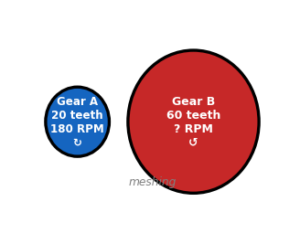 Correct
Gear ratio = 20:60 = 1:3. Since Gear B has 3 times as many teeth as Gear A, it rotates 3 times slower. Speed of Gear B = 180 / 3 = 60 RPM. Because meshing gears rotate in opposite directions, Gear B rotates counterclockwise.
Incorrect
Gear ratio = 20:60 = 1:3. Since Gear B has 3 times as many teeth as Gear A, it rotates 3 times slower. Speed of Gear B = 180 / 3 = 60 RPM. Because meshing gears rotate in opposite directions, Gear B rotates counterclockwise.
-
Question 24 of 30
24. Question
Refer to the figure. What is the maximum force that can be exerted by the large piston?
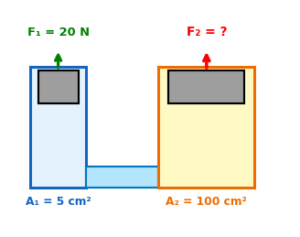 Correct
By Pascal’s law: F1/A1 = F2/A2. So F2 = F1 x (A2/A1) = 20 N x (100/5) = 20 x 20 = 400 N.
Incorrect
By Pascal’s law: F1/A1 = F2/A2. So F2 = F1 x (A2/A1) = 20 N x (100/5) = 20 x 20 = 400 N.
-
Question 25 of 30
25. Question
Refer to the figure. What effort force is required to lift the load?
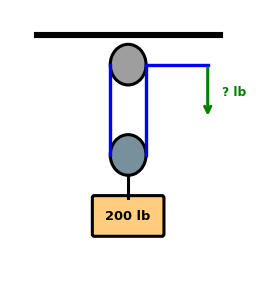 Correct
This is a simple movable pulley system providing 2:1 mechanical advantage. Effort = Load/2 = 200/2 = 100 lb.
Incorrect
This is a simple movable pulley system providing 2:1 mechanical advantage. Effort = Load/2 = 200/2 = 100 lb.
-
Question 26 of 30
26. Question
Refer to the figure. Ignoring friction, what force parallel to the plane is needed to push the box up?
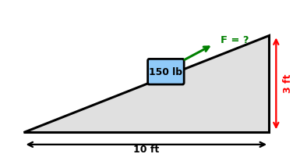 Correct
Force = Weight × (height / length) = 150 lb × (3 / 10) = 45 lb
Incorrect
Force = Weight × (height / length) = 150 lb × (3 / 10) = 45 lb
-
Question 27 of 30
27. Question
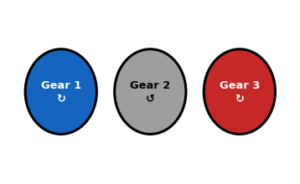
Refer to the figure. If Gear 1 rotates clockwise, in what direction does Gear 3 rotate?
 Correct
With 3 gears in series: Gear 1 (clockwise) → Gear 2 (counterclockwise) → Gear 3 (clockwise). An odd number of gears means the input and output gears rotate in the same direction.
Incorrect
With 3 gears in series: Gear 1 (clockwise) → Gear 2 (counterclockwise) → Gear 3 (clockwise). An odd number of gears means the input and output gears rotate in the same direction.
-
Question 28 of 30
28. Question
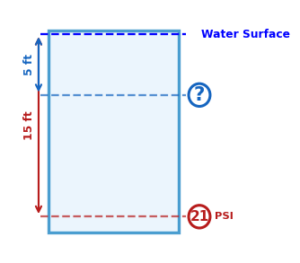
Refer to the figure. At 15 ft depth, the pressure is 21 PSI. What is the pressure at 5 ft depth?
 Correct
Water pressure increases linearly with depth. At 15 ft = 21 PSI, so pressure increases by 21/15 = 1.4 PSI per foot. At 5 ft: 5 × 1.4 = 7 PSI.
Incorrect
Water pressure increases linearly with depth. At 15 ft = 21 PSI, so pressure increases by 21/15 = 1.4 PSI per foot. At 5 ft: 5 × 1.4 = 7 PSI.
-
Question 29 of 30
29. Question
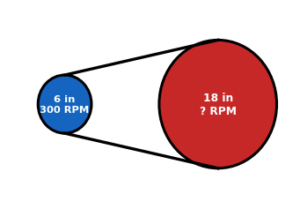
Refer to the figure. If the driving pulley rotates at 300 RPM, what is the speed of the driven pulley?
 Correct
Speed ratio is inversely proportional to diameter ratio means if one pulley is larger, it rotates more slowly. The formula for belt‑driven pulleys is: Speed2 = Speed1 × (D1 / D2) = 300 × (6/18) = 300 × (1/3) = 100 RPM.
Incorrect
Speed ratio is inversely proportional to diameter ratio means if one pulley is larger, it rotates more slowly. The formula for belt‑driven pulleys is: Speed2 = Speed1 × (D1 / D2) = 300 × (6/18) = 300 × (1/3) = 100 RPM.
-
Question 30 of 30
30. Question
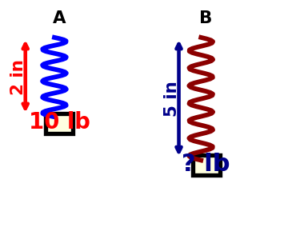
Refer to the figure. What is the weight causing the 5-inch compression?
 Correct
By Hooke’s law, force is proportional to compression. If 10 lb causes 2 in compression, then spring rate = 10/2 = 5 lb/in. For 5 in compression: Force = 5 x 5 = 25 lb.
Incorrect
By Hooke’s law, force is proportional to compression. If 10 lb causes 2 in compression, then spring rate = 10/2 = 5 lb/in. For 5 in compression: Force = 5 x 5 = 25 lb.
Next Practice Test
OAR Practice Test 2 >>